REVIEW · ROME
Rome Golf Cart Tour: Discover the Pinnacle Experience
Book on Viator →Operated by Dolce Vita Tours · Bookable on Viator
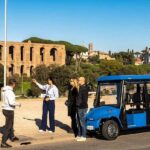
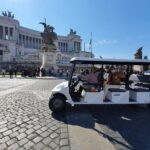
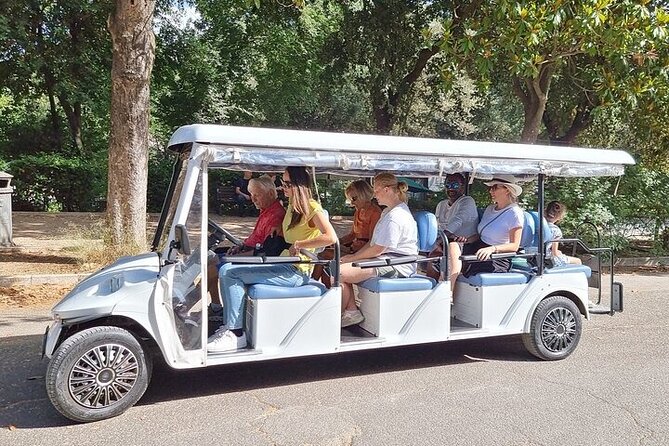
Rome by golf cart feels like cheating. You trade long walks for quick, scenic hops between Rome’s most famous sights and a few calmer corners, all with an English-speaking driver and a ride that keeps you above the traffic chaos. I like the complimentary central Rome pickup most, because it cuts the first-stress problem. I also love how the guides (Francesco, Sabrina, Claudio, Marco, Ivanna, and others) turn the drive into a real show with humor and fast context. The main drawback to expect is timing: with a 3-hour schedule, most stops are short, and you may need to skip anything that requires longer-than-a-photo time.
Because it’s Rome, you can choose a morning, afternoon, or evening start and still hit the highlights. You’ll also be using your eyes more than your legs thanks to the open-air cart view. Just know the tour includes sightseeing access, not attraction tickets, so plan for the fact that some places (like the Pantheon) are not covered.
In This Review
- Key Highlights to Expect From This Rome Golf Cart Tour
- Why a Golf Cart Can Be the Smart Move in Rome
- Price and Value: What $396.48 Buys You
- Pickup, Meeting Point, and How the 3-Hour Timeline Feels
- Stop-by-Stop: How the Route Hits Rome’s Big Characters
- Pantheon First: Ancient Engineering Still Pulls Its Weight
- Piazza Navona and the Baroque Stage Set
- Trevi Fountain and Spanish Steps: The Classic Photo Circuit
- Campo de’ Fiori: Rome’s Colors and the Darker Note
- Villa Borghese, Palatine Hill, and Circus Maximus: When Rome Feels Big
- Sant’Ignazio, Piazza Venezia, and the Forum Orbit
- Chiesa di Sant’Ignazio di Loyola: Jesuit Style with Calculated Drama
- Mausoleum of Augustus and the Column in Piazza Colonna
- Piazza Venezia and the Imperial Forums Context
- Aventine Hill Views: Orange Garden and the Mouth-of-Truth Moment
- Giardino degli Aranci: Best Pause for a View
- Piazza della Bocca della Verità: A Short Stop with Big Story Power
- Temple of Hercules and Portunus and Teatro di Marcello: Ancient Works Close to the River
- Guide Style: Why This Tour Feels Like More Than Transport
- Practical Tips to Make This Work for You
- Bring your stamina, not your walking shoes
- Plan your must-sees before you arrive
- Expect short stops, then follow up on your own
- Choose your start time based on your energy
- Should You Book This Rome Golf Cart Tour?
- FAQ
- What is the duration of the Rome golf cart tour?
- How much does the tour cost?
- Does it include hotel pickup?
- Where does the tour start and end?
- What language is the tour offered in?
- Are attraction tickets included?
- Is the tour private?
- How long are the stops?
- Is a mobile ticket provided?
- Can I cancel and get a refund?
Key Highlights to Expect From This Rome Golf Cart Tour
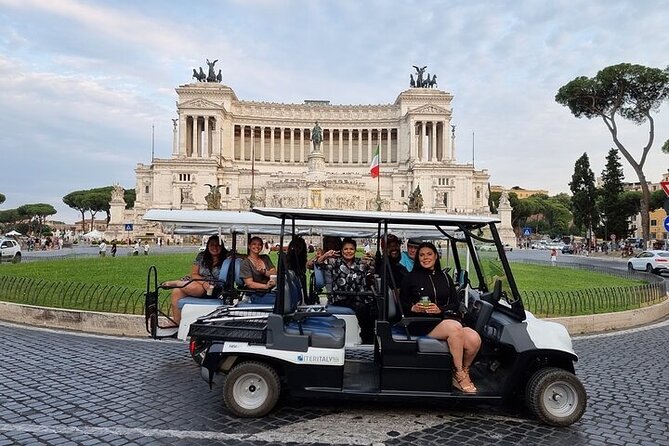
- Hotel pickup in central Rome saves you from figuring out buses and crowded sidewalks.
- An English-speaking driver who talks history and street-level details as you roll between stops.
- Big-name landmarks plus short photo breaks across several neighborhoods in about 3 hours.
- A route that can sometimes flex when guides have room to accommodate requests (like the Vatican drive-by in one case).
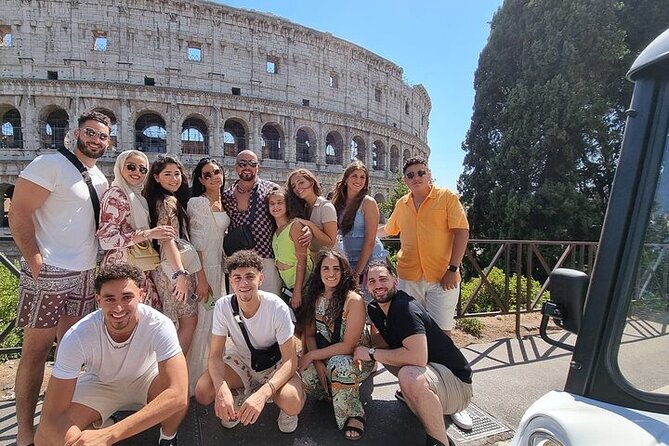
- Great for kids and older travelers—some guides even add play moments and keep the pace gentler for canes and mobility needs.
- Panoramas on the hills—including a stop at the Orange Garden on the Aventine.
Why a Golf Cart Can Be the Smart Move in Rome
Rome is glorious, but it’s also relentless. Sidewalks are uneven, crowds pack the sidewalks, and every “quick stop” can turn into 30 minutes of wandering. A golf cart tour helps because it compresses distance without taking away all the sightseeing drama.
This tour is priced at $396.48 per person for about 3 hours, and that sounds steep until you translate it into what it replaces: taxis, time lost to transport, and the energy cost of walking between far-apart sites. For many people, the value is strongest when you want a first pass over Rome—then you can return on foot to what you actually love.
The other win is how you see the city. Sitting higher than a car seat (and usually with fresh air) makes the views feel quicker and more complete, especially around the hills and big squares.
You can also read our reviews of more tours and experiences in Rome.


Price and Value: What $396.48 Buys You
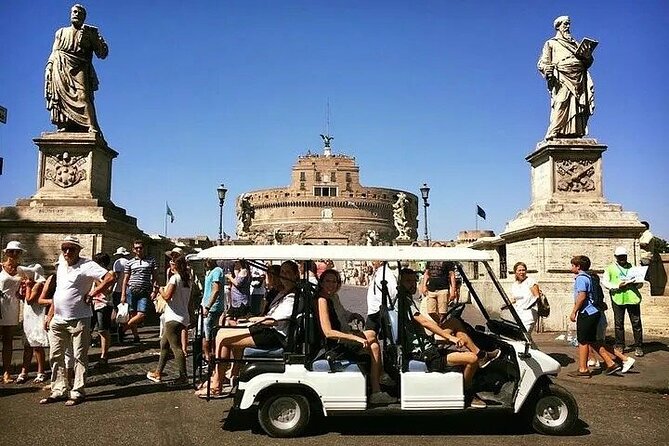
At $396.48 per person, you’re paying for three things:
1) A private experience feel (only your group participates)
2) Dedicated driving and interpreting time rather than self-guided transit
3) Hotel pickup in central Rome plus a planned set of stops
What you don’t get is attraction entry included. The tour is built for seeing and learning on the move, not for waiting in lines or doing timed entry deep-dives at multiple paid sites. The Pantheon is specifically called out as admission ticket not included, while several classic stops are free to enjoy (squares and views).
So the value check is simple: if you want a “Rome sampler” with a guide and minimal logistics pain, this can feel worth it. If you want to spend lots of time inside museums and paid monuments, you’ll likely feel time-pressure.
Pickup, Meeting Point, and How the 3-Hour Timeline Feels
The ride starts and ends at Piazzale delle Canestre, SNC, 00197 Roma RM. You also get complimentary hotel pickup in central Rome for the private experience. If you’re not in the center, they say to contact them and a private car might be arranged.
Here’s the key practical point: with an easy pickup, you can show up already calm. But if you’re meeting at Piazzale delle Canestre, plan to arrive a touch early. One review mentioned it was a little hard to identify the right cart and required walking to find the correct group.
Expect the day to move fast. Several stops list 5–15 minute durations, and many others don’t specify time at all—so in practice, you should assume short viewing windows, quick stories, and frequent “look left, now look right” moments.
Stop-by-Stop: How the Route Hits Rome’s Big Characters
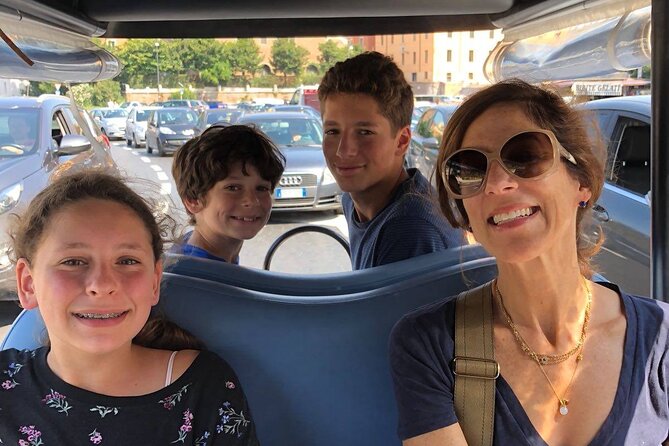
This route mixes ancient Rome, Baroque Rome, and hilltop viewpoints. It’s also designed so you’re not just looking at buildings—you’re getting a mental map of how Rome layers over itself.
Pantheon First: Ancient Engineering Still Pulls Its Weight
The tour starts at the Pantheon, a former Roman temple later transformed into a Catholic church in 609 AD. It’s a 15-minute stop, and admission is not included.
What makes this start smart: it sets the tone immediately. Even if you’ve seen photos, standing close helps you understand why Romans built it so boldly—and why later generations kept it at the center of Roman religious life. The short time works best if you’re in a “get the idea first” mode rather than a “read every inscription” mode.

Piazza Navona and the Baroque Stage Set
Next up is Piazza Navona, built on the remains of Domitian’s Stadium. The stop is about 10 minutes and entry is free.
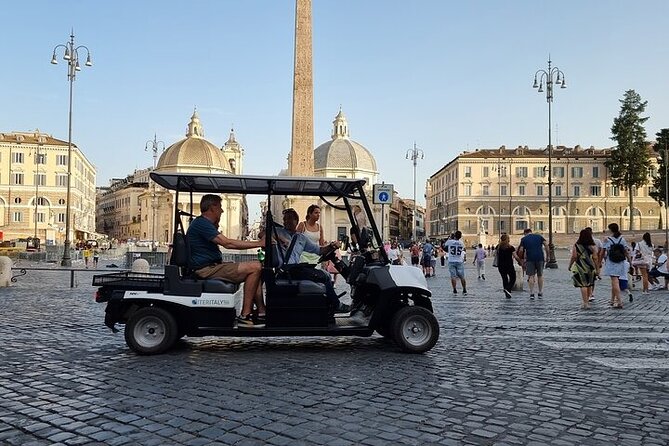
Navona is a perfect golf-cart stop because it’s made for quick orientation: you see the square, you notice the layout, and you can feel the energy without committing to long museum time. If you’re the type who likes to sketch or take golden-hour photos, you’ll probably wish you had more time—but the tour uses this stop as a momentum builder.
Trevi Fountain and Spanish Steps: The Classic Photo Circuit
Then you hit Trevi Fountain (about 10 minutes, free) followed by the Spanish Steps (about 5 minutes, free).
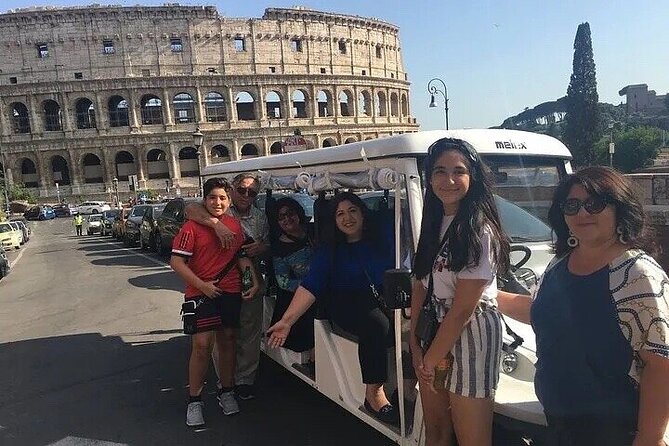
This is where a cart tour earns its keep. In busy Rome, walking between Trevi and the Spanish Steps can mean threading through crowd choke points. By contrast, the cart gets you close quickly, and the guide’s timing helps you get the key angles even when streets are packed.
Campo de’ Fiori: Rome’s Colors and the Darker Note
After that, you’re guided to Piazza Campo de’ Fiori—described as one of the souls of Rome. The centerpiece is the statue of philosopher Giordano Bruno, who was burned alive in the square.
This stop is interesting because it adds a different flavor than fountains and temples. You get to see Rome as a place where ideas, power, and punishment all played out in public space. Expect a shorter pause rather than a long sit-down, but it can stick with you more than the usual skyline shots.
Villa Borghese, Palatine Hill, and Circus Maximus: When Rome Feels Big
Your route then swings through major ancient and park areas, including Villa Borghese (public park), Palatine Hill (called the center most of the seven hills and the first nucleus of the Roman Empire), and Circus Maximus (ancient chariot-racing stadium).
This is where you need to calibrate expectations. In a 3-hour format, you’re unlikely to do these like a full archaeological day. Think of it as viewing-and-context time: you’ll get the big “what this is” and “why it matters” stories, then you can decide if you want to come back for deeper exploration on your own.
Sant’Ignazio, Piazza Venezia, and the Forum Orbit
The tour includes church architecture and major civic spaces that connect the old city to Rome’s newer monuments.
Chiesa di Sant’Ignazio di Loyola: Jesuit Style with Calculated Drama
One stop is Chiesa di Sant’Ignazio di Loyola. It’s a free stop (about 10 minutes listed) tied to Jesuit building design and famous artistic planning.
If you care about how buildings communicate power, this is a great mid-route break. Even a quick look can show you the difference between Rome’s ancient stone language and its later religious storytelling—especially when the guide points out what you might otherwise miss.
Mausoleum of Augustus and the Column in Piazza Colonna
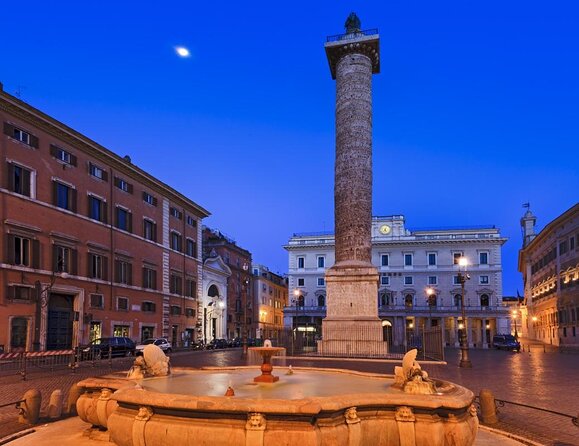
You’ll also pass the Mausoleum of Augustus, described as key for the reuse and reinterpretation of antiquities over time, plus the Column of Marcus Aurelius and Faustina in Piazza Colonna.
These stops matter because they anchor Rome in its “official memory.” They’re not just pretty structures; they’re visual statements from emperors about legitimacy and legacy. Again, with a tight schedule, you’re getting snapshots—not full study.
Piazza Venezia and the Imperial Forums Context
Piazza Venezia is included, tied to the construction of the Monumento a Vittorio Emanuele II. The route also calls out a museum stop focused on Mercati di Traiano and an introduction to the Imperial Forums, with multimedia and explanatory panels.
Important expectation: attraction access is not included, so you may get exterior viewing and orientation, and you might not spend much time inside unless your ticket plan works out.
Aventine Hill Views: Orange Garden and the Mouth-of-Truth Moment
Giardino degli Aranci: Best Pause for a View
The Giardino degli Aranci (Orange Garden) is a standout stop on the Aventine Hill. It’s listed as about 15 minutes and is free. The tour notes you get a panorama over Rome, and if there is time, there may also be a stop for the Keyhole of Rome.
In a tour full of squares and buildings, this is your breathing space. It’s where you slow down for a second, look across the city, and connect the dots between hills and landmarks.
Piazza della Bocca della Verità: A Short Stop with Big Story Power
Then it’s Piazza della Bocca della Verità with the Mouth of Truth. The listed time is about 5 minutes and the stop is free.
This one’s quick, but it works because it gives you a story you can carry into your evening walk. If you like myth and superstition as much as stone and marble, you’ll enjoy the angle.
Temple of Hercules and Portunus and Teatro di Marcello: Ancient Works Close to the River
The route includes Temple of Hercules and Portunus (near the Tiber) and the theatre of Marcellus.
These are the kinds of sights that feel more real when you see them outside a museum context. They also help you understand how Rome wasn’t only monuments—it was also infrastructure for commerce, performance, and daily life.
And since your time is limited, these quick stops can be a smart trade: you get the “wow, that’s Roman” moment without the hours-long commitment.
Guide Style: Why This Tour Feels Like More Than Transport
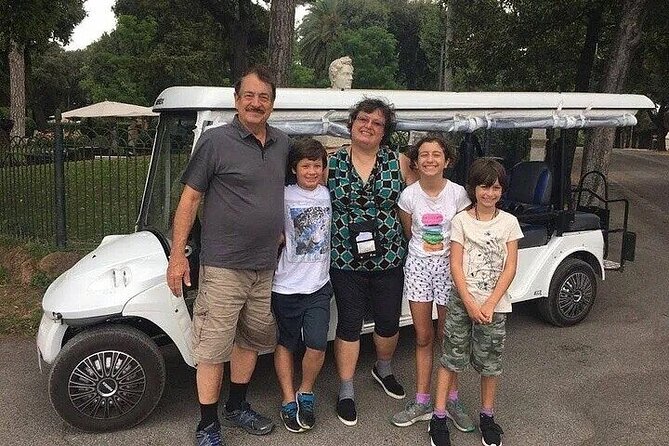
What repeatedly shows up in guide descriptions is not just information—it’s personality.
- Francesco is praised for charm and clear English, with a lot of facts packed into the ride.
- Sabrina comes up when people want flexibility, including stops beyond the central district.
- Claudio and Marco show up as fun, capable, and great at moving through traffic safely.
- Ivanna is highlighted for humor plus customizing the route to what the group already saw.
- Peter gets credit for covering a lot fast, and for making the tour feel smooth even when the plan changes.
Some reviews also mention sweet extras: a gelato stop or an Italian coffee ice being part of the experience. If that’s your style, it’s a nice reminder that these tours can feel less like a checklist and more like a guided day.
One more practical perk: if you have kids, you may want to ask about playful stops. One family suggested asking them to take you to the magic wall, and that small request made the day even better.
Practical Tips to Make This Work for You
Here are the choices that matter most for a smooth day.
Bring your stamina, not your walking shoes
Even with a cart, you’ll still walk a little at each stop. Wear shoes you can handle on Rome’s uneven surfaces. If mobility is an issue, the cart helps a lot, and the pacing is typically gentler than a full-day walking itinerary.
Plan your must-sees before you arrive
If you want something outside the core list—say, you care most about Vatican-area sights, or you want a more off-center route—ask early. The tour is designed to be flexible in spirit, and several guides have shown willingness to adjust when possible.
Expect short stops, then follow up on your own
This is ideal for a first Rome hit. Use it to build your personal “top 5.” Then you can spend a later day going slower at what grabbed you.
Choose your start time based on your energy
The tour offers morning, afternoon, or evening start times. If your goal is photos and you hate crowds, the start time can matter a lot. If your goal is simply getting oriented and rested, pick the time that matches your body, not your calendar.
Should You Book This Rome Golf Cart Tour?
Book it if you want:
- a 3-hour overview that covers big-name landmarks and some quieter ancient areas
- a guide-driven day with hotel pickup in central Rome
- less walking, less transit stress, and an easy way to get your bearings fast
Skip it (or pair it with extra time) if you want:
- long museum sessions, detailed timed-entry experiences, or multiple paid attractions inside the same day
- a super relaxed pace with lots of free wandering at each stop
My bottom line: this is a strong “Rome intro” when you want the classics—Pantheon, Navona, Trevi, Spanish Steps—plus a route that reaches the hills and Forum orbit. Pay attention to what you want most, then use the tour as your map. Rome is big. This helps you learn it without burning out.
FAQ
What is the duration of the Rome golf cart tour?
The tour runs for about 3 hours.
How much does the tour cost?
The price is $396.48 per person.
Does it include hotel pickup?
Yes, there is complimentary hotel pickup in central Rome for the private experience.
Where does the tour start and end?
It starts at Piazzale delle Canestre, SNC, 00197 Roma RM, Italy, and ends back at the same meeting point.
What language is the tour offered in?
The tour is offered with an English-speaking driver.
Are attraction tickets included?
No. Access to attractions is not included. The Pantheon stop specifically notes admission ticket not included, while several stops are free.
Is the tour private?
Yes. It is a private tour/activity, and only your group participates.
How long are the stops?
Stop durations vary. For example, Pantheon is listed at about 15 minutes, Piazza Navona and Trevi Fountain at about 10 minutes, and Spanish Steps at about 5 minutes.
Is a mobile ticket provided?
Yes, the tour offers a mobile ticket.
Can I cancel and get a refund?
Free cancellation is available. You can cancel up to 24 hours in advance for a full refund.