Rome can feel like a puzzle on day one. This golf cart tour gives you a practical route through the essentials—without turning your trip into a long-walk marathon. I love how it strings together the top sites in one efficient format, and I also like that the ride helps you reach streets and viewpoints bigger vehicles can’t handle. One watch-out: the stops are timed, so if you want lots of slow roaming, you may feel you’re moving a bit fast.
The best part is the mix of iconic landmarks and street-level context you can actually use while planning the rest of your Rome days. You’ll start right by the Colosseum area, then keep hopping between classic photo spots and memorable legends, finishing in a different neighborhood so you can keep going. If you’re prone to motion sickness or you hate traffic noise, plan on staying close to your guide and using the cart’s audio if offered.
In This Review
- Key things I’d zero in on
- Why a golf cart tour works so well for Rome
- Starting outside Via del Colosseo: your quick Colosseum orientation
- Mitreo del Circo Massimo: Circus Maximus without the long slog
- Bocca della Verità at Santa Maria in Cosmedin
- Piazza Venezia and Altare della Patria: classic views with real orientation
- Ancient temples, Julius Caesar’s assassination site, and the cat stop
- Piazza Navona and Bernini’s Four Rivers Fountain
- The Pantheon: Roman engineering you can actually see
- Trevi Fountain: the coin moment, with less strain
- What’s included, and what you need to plan for
- How the timing feels in real life
- Who this Rome golf cart tour fits best
- Should you book this Rome Golf Cart Tour?
- FAQ
- How long is the Rome Golf Cart Tour?
- What language is the tour offered in?
- Where do I meet, and where does the tour end?
- What is included in the price?
- Are tickets needed for the stops?
- What group size should I expect?
- What happens if the weather is poor?
Key things I’d zero in on
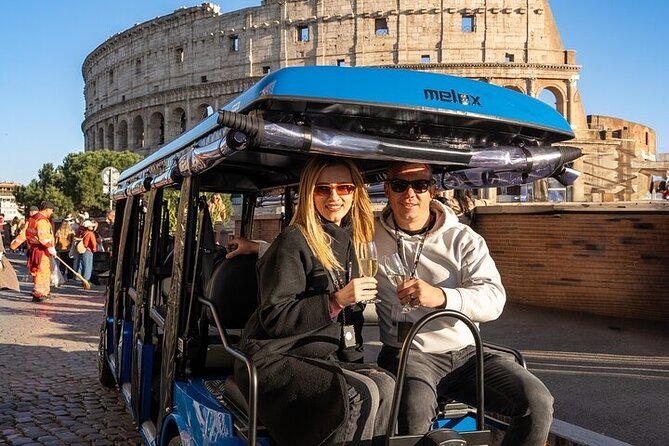
- Colosseum-area start so you get immediate orientation before you commit to other plans
- Small-group size (max 14) for a tour that still feels personal
- Free-at-the-stop highlights at multiple major sites, so you’re not juggling ticket math
- Guides bring the stories (you might be led by names like Federico, Milo, Christina, and others)
- Cart access in tight areas that’s hard or impossible for larger vehicles
- A day-1 confidence builder that helps you choose where to return on foot
Why a golf cart tour works so well for Rome
Rome is gorgeous, and Rome is also built to test your shoes. That’s exactly why this type of tour makes sense early in your trip: you get a “big picture” pass over the major landmarks while still spending your legs for later, on your terms.
What you’re paying for isn’t just transportation. It’s time management. A 2 to 2.5 hour window can be the difference between feeling lost and feeling oriented. I also like that the tour format is designed to reduce fatigue—so the experience stays fun even if you’re traveling with kids, older relatives, or just jet-lagged.
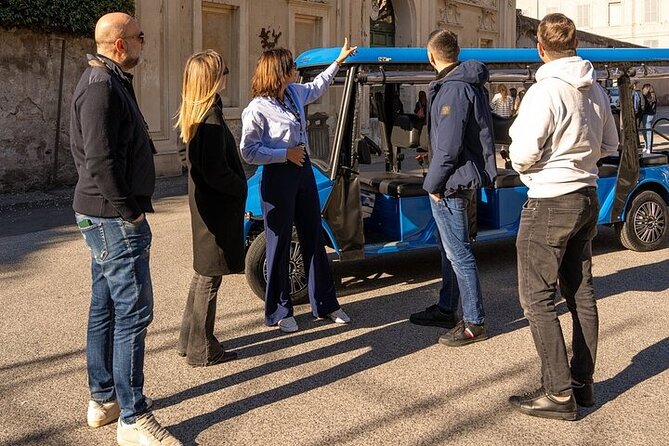
There’s another practical angle. A golf cart can fit where regular buses and larger vehicles can’t, meaning you can often see and stop closer to the action than you’d get from a purely bus-based route. That matters when you want photos that include real context, not just distant views.
You can also read our reviews of more tours and experiences in Rome.
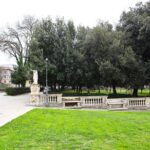


Starting outside Via del Colosseo: your quick Colosseum orientation
Your meeting point is Via del Colosseo, 31. You’ll begin outside the Colosseum area—close enough that the moment you park, your brain snaps into place. This is a smart move for first-timers because Rome’s ruins and viewpoints can feel scattered unless someone gives you a clear mental map.
From the start, the tour keeps reminding you that Rome isn’t just “old stuff.” It’s a city of layers. Even before you roll far, your guide’s approach sets expectations: what you’re seeing now connects to what you’ll notice later when you walk around on your own.
You don’t need to sprint or cram. The ride gives you an immediate sense of direction, and the stops that follow are structured so you get famous landmarks and the kind of specific local details that help you recognize what you’re looking at.
Mitreo del Circo Massimo: Circus Maximus without the long slog
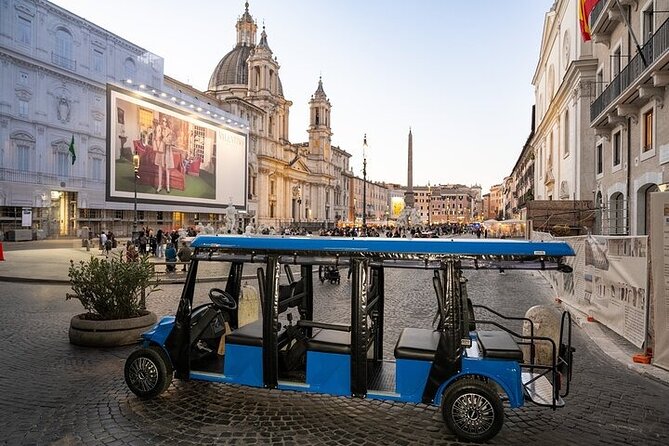
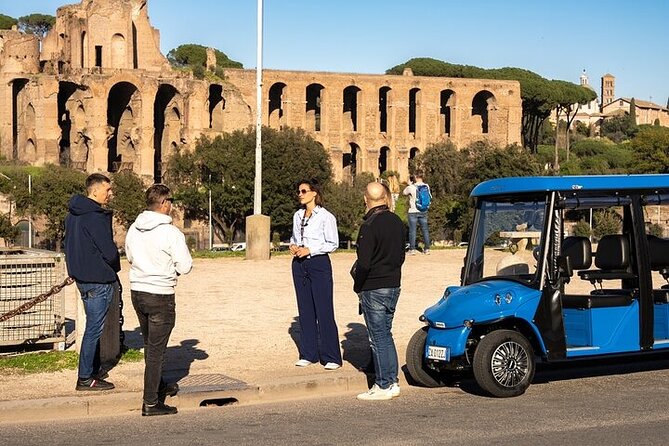
The tour heads to Mitreo del Circo Massimo, near the Circus Maximus. This stop is short—about 20 minutes—but it’s perfectly sized for what it offers: a calm break in the middle of sightseeing chaos.
Circus Maximus was once the center of chariot racing. Now it’s a quieter park space with wide-open sightlines, so you can step back and actually take in the geometry of the area. For photos, the perspective is useful because it shows how Rome’s monumental scale works even when you’re just standing in a modern park.
If you hate the feeling of “I saw it, but I didn’t really look,” this stop helps. You get a quick panoramic moment where your eyes can reset before the next legend-and-landmark burst.
Bocca della Verità at Santa Maria in Cosmedin
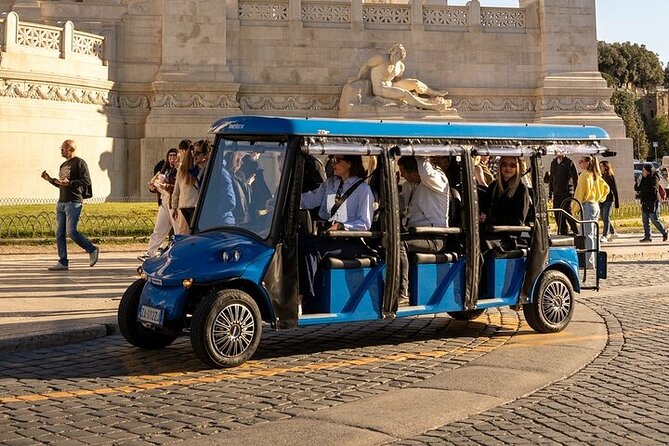
Next up is Bocca della Verità, the famous marble mask at the portico of Santa Maria in Cosmedin. Expect around 20 minutes here, and don’t rush—this stop is part sightseeing, part performance.
The core story is the legend: if you put your hand in the mouth and tell a lie, it’s said you’ll get bitten. Even if you treat the tale as pure theatre, it’s a fun way to break up Rome’s heavier monuments with something playful and instantly memorable.
What makes this stop worth your time is the setting. You’re not looking at an object in a vacuum. You’re in a church-adjacent environment where the legend belongs, and you’ll get context for why the mask became the world-famous symbol it is.
Piazza Venezia and Altare della Patria: classic views with real orientation
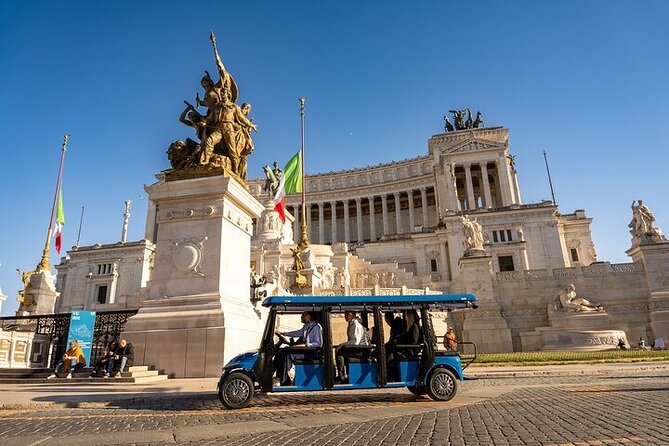
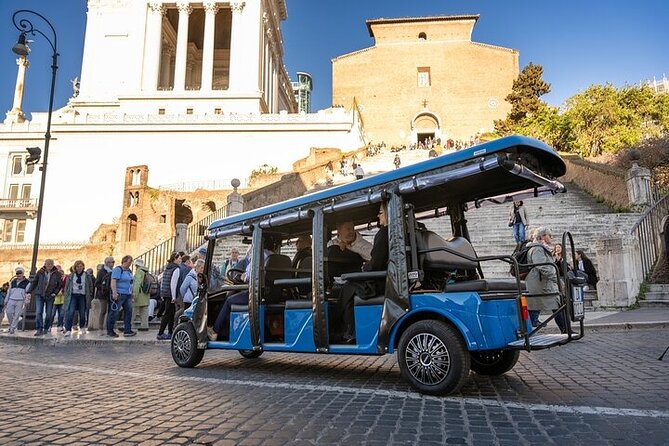
Piazza Venezia is your next major square stop (about 20 minutes). It’s one of those Roman hubs where multiple lines of history and movement meet, and it’s dominated by the imposing Altare della Patria.
This is a great place to pause because you get the kind of view that helps you understand where things are relative to each other. From here, the historic center starts to look like a connected map instead of a pile of separate stops you’re trying to cram into one day.
Also, the square’s energy works well for this tour style. You’re not stuck on a museum clock. You’re getting a landmark moment and a location-reference moment—both useful when you later plan walks, gelato breaks, and dinner.

Ancient temples, Julius Caesar’s assassination site, and the cat stop
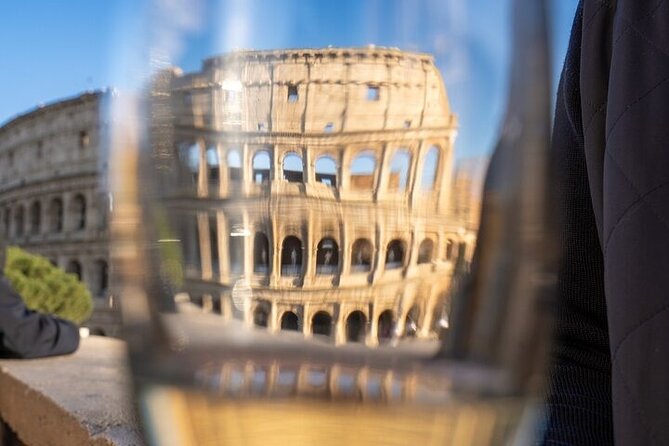
Between the big squares, the route makes a stop for ancient temples and the site of Julius Caesar’s assassination. The tour also includes a famous cat sanctuary stop, which—if you’re even slightly a cat person—turns this portion into a genuine palette cleanser.
You’ll get more meaning out of this section if you let the guide connect the dots. Rome’s story here isn’t just dates. It’s politics, power, and the physical reality of how events happened in the same streets where you’re standing now.
This stop also shows why the golf cart format helps. You’re not just walking from one landmark to the next. You’re getting a sequence of nearby layers that would take time to stitch together yourself—especially if you’re trying to avoid getting turned around.
Piazza Navona and Bernini’s Four Rivers Fountain
Piazza Navona is next, with around 20 minutes on the ground. The headline is Bernini’s Fountain of the Four Rivers—a showpiece where sculpture and symbolism do the heavy lifting.
Navona is also a good test of whether this tour pace suits you. The stop is long enough to enjoy the fountain area and take photos, but it’s not so long that it feels like you’re parked and waiting. That balance is exactly what you want in a fast-orientation tour.
If you like to watch street life, this square gives you enough time to glance around. If you prefer quieter sightseeing, you can still keep your focus on the architecture and fountain details without feeling rushed.
The Pantheon: Roman engineering you can actually see
The route includes a dedicated Pantheon visit, highlighting it as a marvel of Roman engineering—especially its magnificent dome and well-preserved architecture.
This stop matters because the Pantheon is one of those buildings that always looks impressive, but it’s also one where a guide helps you notice what to look for. The dome isn’t just a cool shape. It’s a practical design achievement, and seeing it with context turns it from scenery into understanding.
Even if you’ve seen photos before, the Pantheon has a way of shrinking the distance between “then” and “now.” You’ll leave with a stronger sense of why Romans built in this style—and why it still influences architecture centuries later.
Trevi Fountain: the coin moment, with less strain
Finally, you’ll reach Trevi Fountain, another ~20 minute stop. It’s described as a Baroque masterpiece, and that tracks the moment you see it: layers of stone, dramatic composition, and that unmistakable sense of theatrical scale.
The tour includes the classic tradition tied to the fountain—tossing a coin over your shoulder to ensure your return to Rome. Even if you’ve heard it a hundred times, it lands better when you’re seeing the fountain as part of a planned route rather than as a last-minute scramble.
Practical tip from how these moments usually go: take your time for a couple photos from different angles, then step back. If you do only one quick shot, you’ll regret it later. Rome rewards slow looking even on a fast tour.
What’s included, and what you need to plan for
Here’s the deal on value. You pay $119.47 per person for a licensed guide plus transportation by golf cart. That price makes sense if you value time and comfort, because you’re not hiring a guide just for talking—you’re using the guide to connect sights efficiently.
Multiple stops are listed as admission ticket free, which helps keep costs predictable. Also, since the ride helps you cover a lot without the strain of long walks, you’re effectively buying back energy for your later plans.
What’s not included: pick-up or drop-off. You’ll walk to the meeting point at Via del Colosseo, 31 and you end at Piazza Trilussa. If you’re mapping your day, plan your next activity around that finish location instead of assuming you’ll end near your hotel.
The tour is offered in English and uses a mobile ticket. If you’re the type who forgets to charge your phone, this is your gentle reminder to keep battery life in good shape.
How the timing feels in real life
The tour runs about 2 to 2.5 hours, and the route hits major icons at a quick, stop-by-stop rhythm. That’s the main trade-off. You’ll see a lot, but each stop is designed for highlights, not long-form exploration.
This can be perfect if you’re doing Rome the “choose your base and return later” way. Do this early, get your bearings fast, then circle back on foot to the places you care about most.
It can feel less ideal if you’re the kind of visitor who wants to linger with museum-level attention at every stop. In that case, this tour is still useful as a sampler, but you may want to schedule slower time right after.
Also keep an eye on the group size. The maximum is 14 travelers, so it’s small enough to stay comfortable, but still shared. You’ll get the cart experience without expecting privacy.
Who this Rome golf cart tour fits best
I think this tour is a strong match for:
- First-time visitors who want to cover the highlights and build a plan
- Families or groups where not everyone wants the same walking pace
- Travelers who prefer a comfortable ride and efficient sightseeing
- People who like photo stops but don’t want to wait in lines for every transfer
It may be a weaker fit if you’re only interested in one area of Rome and want a slow, deep walk through it. This tour covers a broad sweep. The payoff is orientation and variety, not total immersion at any single site.
One more practical note: the tour requires good weather. If conditions are bad, it may be rescheduled or you’ll be offered a different date or a full refund. So if you have a very fixed schedule, book with a bit of buffer.
Should you book this Rome Golf Cart Tour?
If your goal is to see the big icons without burning your day on transfers, I’d book this. The route is built for efficient sightseeing, and the format is friendly for mixed ages and energy levels. For the price, you’re getting more than a ride: you’re buying a guided sequence that helps you understand what you’re looking at and where it all fits.
I’d hold off if you’re chasing long, slow visits and detailed time in fewer places. Also, if you’re expecting a private experience for your group, be careful—this is a small-group setup, so plan on sharing the cart.
If you want an easy first-day win in Rome, start here. Then use what you learn to decide what deserves your second pass on foot.
FAQ
How long is the Rome Golf Cart Tour?
It runs about 2 hours to 2 hours 30 minutes.
What language is the tour offered in?
The tour is offered in English.
Where do I meet, and where does the tour end?
You start at Via del Colosseo, 31, 00184 Roma RM and end at Piazza Trilussa, 00153 Roma RM.
What is included in the price?
It includes a licensed guide and transportation by golf cart.
Are tickets needed for the stops?
Multiple stops are listed as Admission Ticket Free, including Circus Maximus/ Mitreo del Circo Massimo, Bocca della Verità, Piazza Venezia, Piazza Navona, and Trevi Fountain.
What group size should I expect?
There is a maximum of 14 travelers.
What happens if the weather is poor?
This experience requires good weather. If it’s canceled due to poor weather, you’ll be offered a different date or a full refund.