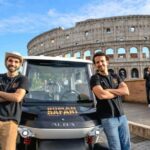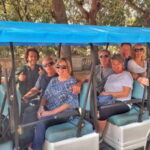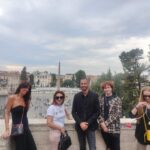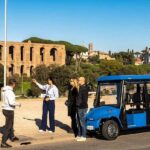
Rome, efficiently, on a silent golf cart. I like that this private electric golf cart tour gives you a 3-hour overview of Rome’s best-known landmarks plus a couple of calmer vantage points.
Two things I really enjoy: the quick stops are paced so you get your bearings fast, and the best views come from places like the Aventine hill area. I also love the payoff at the end—homemade gelato (or tasting wine and Italian snacks, depending on what’s offered that day).
One thing to keep in mind: the price is premium, and the time at each major sight is intentionally short. You’re buying convenience and perspective, not a long, ticket-heavy deep-dive.
In This Review
- Key takeaways before you go
- Why an electric golf cart tour makes sense in Rome
- Pickup, meeting point, and how the tour actually starts
- Trevi Fountain: aqueduct legend and your first postcard moment
- Piazza Venezia and the Monument complex: a quick way to orient the center
- Via dei Fori Imperiali: the straight line that tells a big story
- Teatro di Marcello: ancient performances without the modern distractions
- Circo Massimo: the stadium that shaped Roman mass entertainment
- Giardino degli Aranci: rooftop views from the Aventine
- Arch of Constantine and the Colosseum: when the tour turns into pure wow
- That stop about the first condominium in ancient Rome
- Basilica di Santa Maria Maggiore: the calm shift after the big monuments
- Turo Aventi (Aventine hill): quieter Rome and a final walk-friendly finish
- Gelato, wine, and snacks: the included treat that matters
- Guides: what you should expect from the narration
- Timing and value: can you really see Rome in 3 hours?
- Price and logistics: what you’re paying for at $118.95
- Who should book this private golf cart tour
- Should you book it?
- FAQ
- How long is the tour?
- How much does the tour cost?
- Does the tour include hotel pickup and drop-off?
- Where does the tour start?
- Is the tour private?
- What food or drinks are included?
- Is the tour offered in English?
- Is it wheelchair accessible?
- Is there a minimum age?
Key takeaways before you go
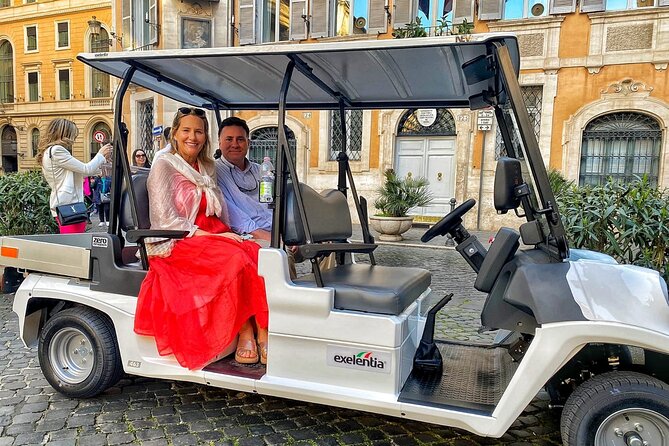
- Private, customizable tour with only your group
- Hotel pickup and drop-off available, plus a clear start point at Piazza della Repubblica
- Electric golf cart makes crowded streets easier, cooler, and less tiring
- Aventine viewpoints plus classic Rome in one smooth loop
- Homemade gelato or tasting wine and Italian snacks included at the end
- Insurance included, with the tour offered in English
Why an electric golf cart tour makes sense in Rome
Rome looks close on a map, but in real life you’re constantly negotiating cobblestones, crowds, and hill climbs. A private electric golf cart changes the rhythm. You still see the key monuments, but you spend more time looking at Rome and less time fighting for position on foot.
The other advantage is comfort. In summer heat or anytime you’re walking in “tourist mode,” the cart keeps your energy for the stops that matter most. That means you can enjoy the small moments—like catching a skyline view from the Aventine—without arriving exhausted.
This kind of tour works best when you want context. Think of it as your orientation drive-through, followed by your own follow-up visits later.
You can also read our reviews of more private tours in Rome

Pickup, meeting point, and how the tour actually starts
The tour meets at Piazza della Repubblica 48, 00184 Rome (front of the hotel Anantara). If you’re staying nearby, hotel pickup and drop-off are available, and you can typically start and end at your hotel.
You’ll also have a mobile ticket, and the tour runs in English. That matters because a good narration turns quick photo stops into something useful—you’ll know what you’re looking at while you’re still in the moment.
Since this is a private tour, you’re not stuck in a cattle-car schedule. Your guide can help you manage timing, the cart route, and when it makes sense to step off for photos.
Trevi Fountain: aqueduct legend and your first postcard moment
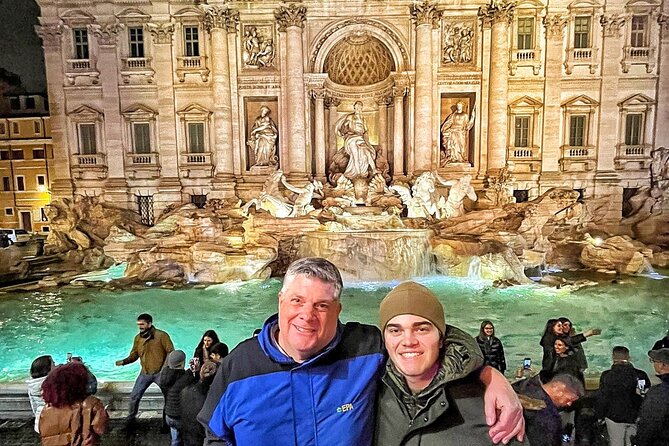
Your first big stop is Trevi Fountain, usually the moment when Rome feels real again. It sits at the junction of three roads—tre vie, literally three ways. And it’s tied to the revived Acqua Vergine (Aqua Virgo) aqueduct, with a legend about a source of pure water found about 13 km (8.1 miles) from the city.
You’ll get about 20 minutes here. That’s enough time to do the classic views, grab photos, and still listen to what makes the fountain more than a busy fountain crowd.
Practical tip: treat Trevi as a “see it now, enjoy it later” stop. If you want deeper time at the fountain itself, schedule that on a separate visit after this tour gives you the lay of the land.
Piazza Venezia and the Monument complex: a quick way to orient the center
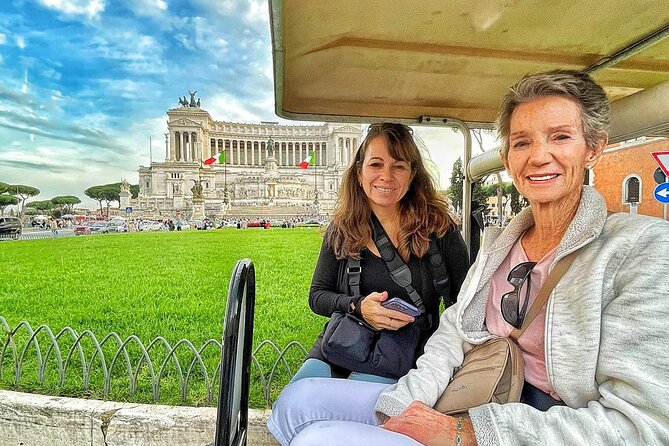
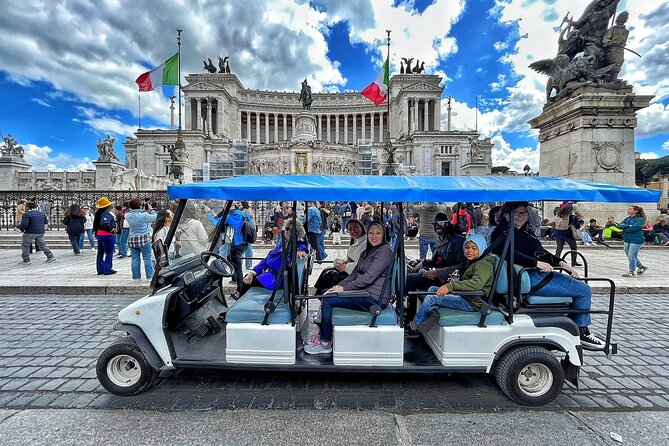
Next comes Piazza Venezia / Ancient City, a square that’s more than a traffic hub. One side connects to Italy’s Tomb of the Unknown Soldier, and the area is tied into the Monument to Vittorio Emanuele II (including the altar space).
You’ll have around 10 minutes. That’s short, but it’s enough to understand where you are relative to the next landmarks—especially when your route heads toward the imperial forums and the Colosseum direction.
If you like symbolism and city layout, this stop is handy. Piazza Venezia is one of those places that makes Rome’s “major axis” logic click.
Via dei Fori Imperiali: the straight line that tells a big story
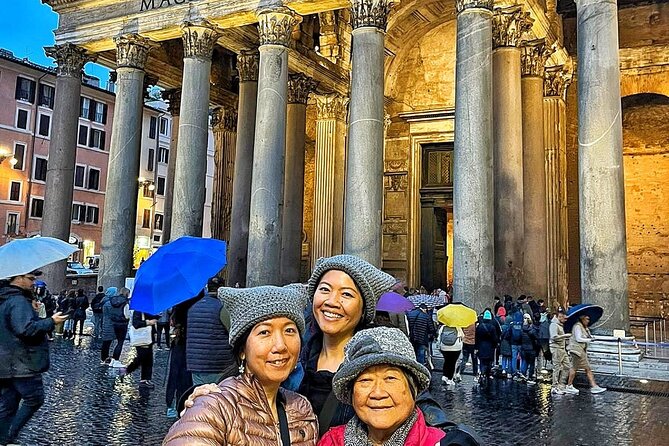
Then you roll along Via dei Fori Imperiali, which runs straight from Piazza Venezia to the Colosseum. This road crosses over sections of several ancient forum areas, including the Forum of Trajan, Forum of Augustus, and Forum of Nerva.
You’ll have about 10 minutes. You’re not walking a full museum circuit here. Instead, you’re getting a rapid sense of how ancient Rome was planned—power, ceremony, and public life laid out with serious geometry.
The drawback: because it’s a short stop, you won’t be able to fully explore at ground level during this tour. But you’ll come away with enough orientation to know where to return if something really grabs you.



Teatro di Marcello: ancient performances without the modern distractions
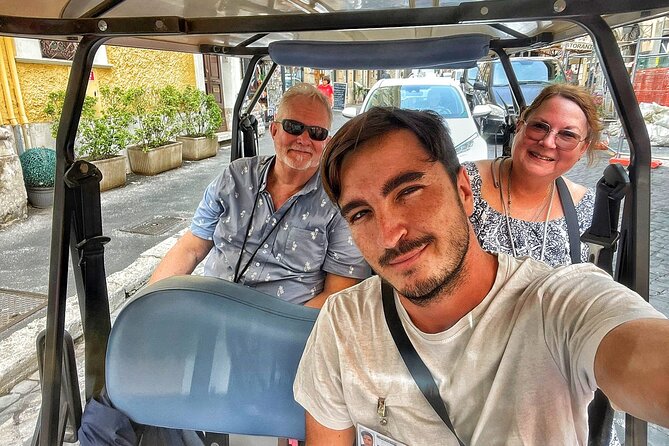
A standout quick stop is Teatro di Marcello—an ancient open-air theater built in the closing years of the Roman Republic. It’s the kind of site that feels “everyday Roman” compared with the blockbuster scale of the Colosseum.
You’ll spend about 10 minutes. In that time, you can see the structure and hear what it was used for: drama, song, and public performances for both locals and visitors.
This is also one of the more relaxing stops because it doesn’t force constant crowd pressure the way the most famous squares can. It’s a good moment to slow down, look at the stone angles, and imagine the sound in an outdoor space.
Circo Massimo: the stadium that shaped Roman mass entertainment
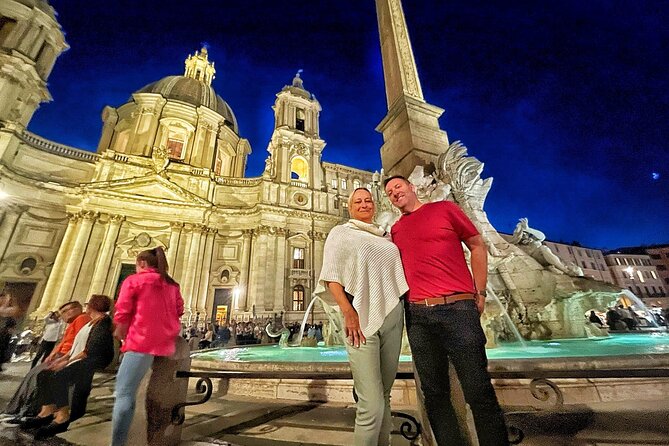
Next is Circo Massimo, the ancient chariot-racing stadium and entertainment venue. It sits in the valley between the Aventine and Palatine hills, and it was Rome’s first and largest stadium in both the republic and later empire periods.
You’ll have around 10 minutes. It’s enough time to understand the scale and notice how the setting between hills creates a natural stage.
If you’re into spectacle, this stop helps connect the dots between empire power and public entertainment. Rome wasn’t only monuments—it was also crowds, events, and drama in public spaces.
Giardino degli Aranci: rooftop views from the Aventine
Then you climb to Giardino degli Aranci (Orange Garden). This is one of the tour’s most “you should take a minute here” moments, even if you’re not an official garden person.
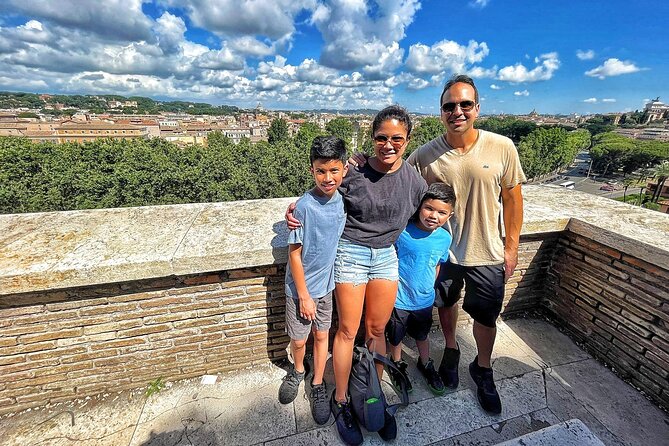
You’ll get about 20 minutes, with classic rooftop views of Rome from the Aventine hill. It’s one of those spots where you can actually breathe and see Rome as a layered city, not just a list of landmarks.
This is also where the cart quietly earns its keep. You’re not walking the full hill with heavy camera bags and heat beating down. You arrive ready to look.
Arch of Constantine and the Colosseum: when the tour turns into pure wow
From Arch of Constantine, you’ll pick up another big context piece. Victory arches are described as a Roman invention, and this one is preserved as part of Constantine the Great’s legacy.
Then comes the Colosseum, the headline stop. You’ll have about 15 minutes. Even in a short visit, it’s the kind of place that instantly gives you scale: the Flavian amphitheater, the gladiatorial spectacle, and the idea of emperors winning public favor with mass events.
A reality check: fifteen minutes is not a substitute for a full Colosseum visit. But as part of a cart tour, it’s ideal for your first emotional hit and your quick understanding of what you’re seeing.
If you care about photos, plan for this to be your main shoot. If you care about learning, use the guide’s narration to mark what you want to study later.
That stop about the first condominium in ancient Rome
In the middle stretch you’ll also stop to learn about the so-called first condominium in the world, from ancient Rome. The label itself points you toward the idea of multi-family, apartment-style living in ancient times.
Because the exact site isn’t spelled out in the details provided, treat this as a “concept stop” more than a long viewing platform. It’s still valuable. Rome isn’t only about emperors and temples—you also get a glimpse of how ordinary (and not-so-ordinary) people lived, stacked in the city’s built environment.
If this topic interests you, you’ll likely want to read up more after the tour. This is the kind of clue that turns curiosity into a follow-up mission.
Basilica di Santa Maria Maggiore: the calm shift after the big monuments
After the Colosseum area, the tour moves toward Basilica di Santa Maria Maggiore, a major church dedicated to the Virgin Mary. It’s described as the largest temple dedicated to the Virgin Mary in Rome and one of the most important in the world.
You’ll have about 15 minutes. That’s a good amount of time for a quick interior look and a respectful pause before you head to the last hill-and-views moment.
A practical note: churches can still be busy, and entrances may have their own rules. Fifteen minutes can disappear fast if there’s a queue. So focus on your first impression first, and if you want more, plan another visit.
Turo Aventi (Aventine hill): quieter Rome and a final walk-friendly finish
The last stop is Turo Aventi on the Aventine hill, one of Rome’s seven hills. This area was once a suburb, later becoming an important center of Christian worship. Today, it’s still described as a calmer place, away from the noise below.
You’ll have about 15 minutes, and it’s framed as a pleasant walking area. This is a nice way to end the tour because it shifts you from “photo sprint” mode into “slow look” mode.
If you like views, this finish complements the Orange Garden stop earlier. You end the loop with a sense of where Rome feels quieter and more lived-in.
Gelato, wine, and snacks: the included treat that matters
This tour includes a stop for gelato homemade or, depending on the option, a tasting wine and Italian snacks. Either way, it’s built as the friendly ending—something to reward you after a fast overview tour.
In the feedback tied to this experience, the gelato is repeatedly called out as a highlight, including comments that it was the best they had in Italy. That tracks with why this kind of tour feels good: you’re not just shuttled between monuments. You get a real local-food moment at the end.
Practical tip: if you’re on the wine-snack option, pace yourself. The tour is only about three hours, and you still want energy to walk on your own later.
Guides: what you should expect from the narration
This experience is offered in English, and the guides named in the supplied details—Stefano, Matteo, Margarita, and Christian—are consistently highlighted for turning short stops into clear explanations and good pacing.
What I’d watch for when you book: ask your guide to point out one thing you might otherwise miss—like why Via dei Fori Imperiali matters, or what Circo Massimo was used for beyond the name. When they do that well, your short time at each site becomes more meaningful.
Also, a strong guide can help you with the “what next” question. Since the tour is about orientation, the best guides give you smart suggestions for what to revisit afterwards.
Timing and value: can you really see Rome in 3 hours?
Yes, but with the right mindset. The tour is designed as a quick loop, with most stops around 10 minutes, plus a few longer moments like Trevi Fountain (20 minutes) and Giardino degli Aranci (20 minutes), and Colosseum (15 minutes).
That structure is a feature. You’ll get enough time to identify what you like, then you can return later for a slower visit. If you treat it like a full day of museum-style sightseeing, you’ll feel rushed.
What makes it better is the format: the electric cart keeps you moving efficiently, and the route connects major anchors without forcing you to cross the city on foot.
Price and logistics: what you’re paying for at $118.95
At $118.95 per person for an approx 3-hour private tour, the price is definitely not “budget Rome.” You’re paying for a combination of things:
- Private electric cart instead of a shared group vehicle
- Hotel pickup and drop-off (when available for your location)
- English-speaking guide narration throughout
- Insurance included
- Gelato or tasting wine and Italian snacks at the end
- Practical add-ons like restaurant recommendations
One caution: admission is listed as free at the stops, which is helpful, but it also means you’re not buying a ticket-heavy experience. If what you want most is multiple paid-entry venues, you may feel like the value is thin.
This tour is at its best when you want a high-efficiency overview and a smooth, low-stress way to decide what deserves your deeper attention later.
Who should book this private golf cart tour
I think this tour fits well if you:
- Want a fast orientation to central Rome without doing a long walking day
- Prefer less crowded movement and a cooler way to cover distance
- Like views and quick context at multiple sites, from Trevi to the Aventine
- Want an enjoyable end finish with homemade gelato or Italian snacks and wine
- Need mobility-friendly pacing—especially since it’s listed as suitable for wheelchair (foldable)
If your trip is built around long, slow museum visits or you already know Rome very well, you might want to compare other options that spend more time inside specific sites. This one is made for breadth and bearings.
Should you book it?
If you’re in Rome for a short stay, tired from travel, or you want a smart first pass through the city, I’d say yes. The combination of private cart comfort, Aventine viewpoints, and an included gelato or tasting ending makes it an easy way to get your bearings fast and then choose what to revisit.
I’d think twice if your top priority is long entry times inside major attractions, or if you’re very price-sensitive. In that case, you might prefer a less expensive shared option or a self-guided plan where you control how long you linger at one place.
FAQ
How long is the tour?
It’s about 3 hours (approximately).
How much does the tour cost?
The price is listed as $118.95 per person.
Does the tour include hotel pickup and drop-off?
Yes. Hotel pickup and drop-off are offered, and you can start and end the tour at your hotel if needed.
Where does the tour start?
The meeting point is Piazza della Repubblica, 48, 00184 Rome, in front of the hotel Anantara.
Is the tour private?
Yes. It’s a private tour, so only your group participates.
What food or drinks are included?
The tour includes gelato homemade or a tasting wine option, plus Italian snacks.
Is the tour offered in English?
Yes, it’s offered in English.
Is it wheelchair accessible?
It’s listed as suitable for wheelchair use (foldable).
Is there a minimum age?
No children under 2 years are allowed.