REVIEW · ROME
See Rome in a Day: Private Golf Cart Tour
Book on Viator →Operated by Not boring tours · Bookable on Viator
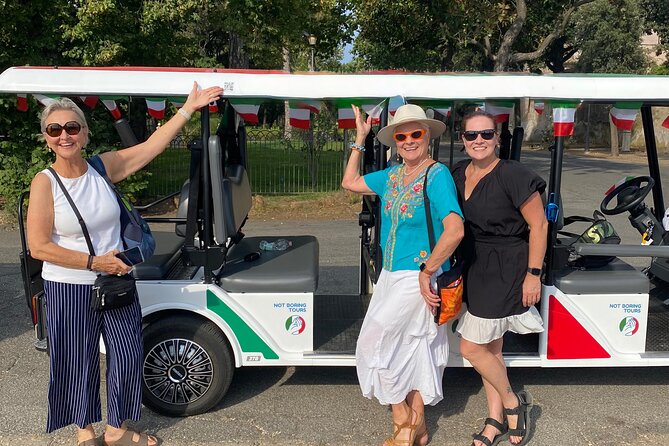
A golf cart tour saves your feet. This private Rome in a day plan is a smart way to see a lot without spending your whole trip crawling between sights. I like that it mixes famous monuments with classic photo viewpoints, all with the convenience of private transportation and hotel-area access.
I also like the flexible feel: it is built around short stops you can adjust to what you care about most. One thing to weigh before you book is the entrance style. The plan notes you do not go inside St. Peter’s Basilica, the Colosseum, or the Pantheon, so if you want long indoor time, you may prefer a different format.
In This Review
- Key things to know before you roll
- Why a golf cart day makes sense in Rome
- The 11:00 route: how the timing and pacing really work
- St. Peter’s Basilica: iconic exterior views with a no-interior plan
- Castel Sant’Angelo: the mausoleum-to-fortress story, plus river views
- Largo Argentina: ancient ruins and the cat sanctuary factor
- Piazza Venezia and the Ancient City viewpoint from above
- Colosseum area from the outside: a fast hit without entry
- San Pietro in Vincoli: Moses, relics, and a quieter kind of wow
- Giardino degli Aranci: a hilltop pause with skyline views
- Circo Massimo and Terrazza del Pincio: big open space plus the best panoramas
- Pantheon neighborhood: a dome you recognize, seen outside
- Santa Maria Sopra Minerva: Gothic church, Michelangelo details, Bernini’s funny sculpture
- Campo de’ Fiori to Piazza Navona: markets by day, party energy by night
- Spanish Steps and Trevi Fountain: two icons that still work when time is short
- Price for a private cart up to 7: is it good value?
- The guide can make or break the day
- Who this tour suits best
- Should you book this golf cart highlights tour?
- FAQ
- What’s the duration of the tour?
- What time does the tour start, and where does it meet?
- Is this a private tour?
- Do we enter St. Peter’s Basilica, the Colosseum, or the Pantheon?
- Is the tour in English?
- What’s included, and what’s not included?
Key things to know before you roll
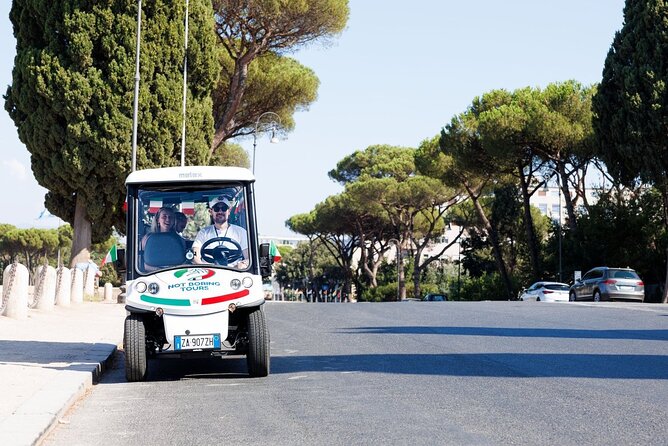
- Private golf cart pace: short, timed stops so you cover many neighborhoods in about 6 hours.
- Views you can photograph fast: rooftops, terraces, and hill lookouts along the route.
- A guide who can shift the emphasis: praised for flexibility and solid Roman context.
- Outside-the-monuments format: you’ll see the major sites without interior visits for three big stops.
- Designed for small groups: up to 7 people, so the experience stays personal.
Why a golf cart day makes sense in Rome
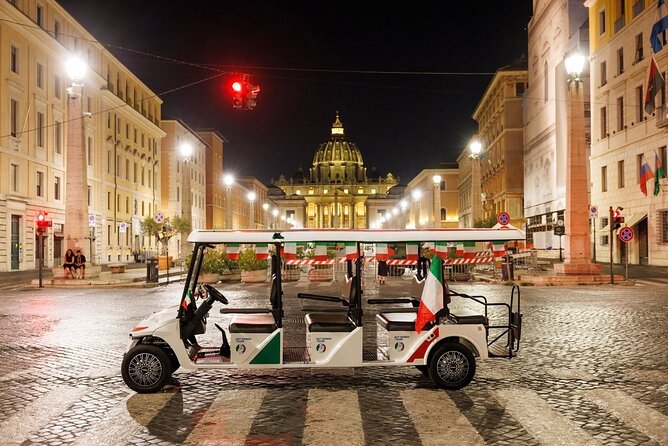
Rome punishes you for slowing down. Between stone steps, tight streets, and long walks from one attraction to the next, an all-day highlights trip can turn into an all-day grind.
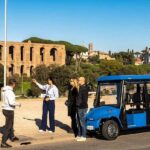
This private cart setup helps you get your bearings fast. You jump between areas that are usually hard to connect smoothly in one day, and you still get “stop, look, shoot photos” time at each place. It feels like a greatest-hits playlist, but with the bonus that the order includes some quieter breathers in between big-ticket stops.
And because it is private, it is not trapped behind a fixed “everyone stay together” pace. If your group is the type that wants one extra viewpoint (or less time at the most crowded corner), you have room to shape the day.
You can also read our reviews of more private tours in Rome

The 11:00 route: how the timing and pacing really work
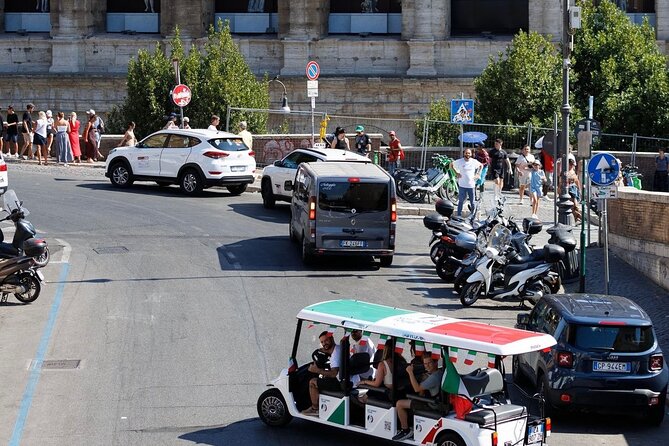
The tour runs for about 6 hours and starts at 11:00 am. The meeting point is Via Santamaura, 12, 00192 Roma RM, and the day ends back there.
This matters more than you might think, because Rome’s traffic and pedestrian zones can turn “one more stop” into a late finish. With a cart, you keep momentum. With short visits at each stop, you avoid the classic trap where you spend an hour looking for the best photo angle and lose the rest of the day.
You will also want to plan your day around walking between viewpoints. Even with a cart, some areas require quick steps and positioning. Nothing about this day suggests it is built for a no-walking itinerary.
St. Peter’s Basilica: iconic exterior views with a no-interior plan
St. Peter’s Basilica is the heart of Vatican City, and it is a place where just seeing the building is enough to make your brain go quiet. You get a 20-minute stop here, with a ticket flagged in the plan, but the tour info also states the route does not include entering St. Peter’s Basilica.
So what’s the value? You get the big exterior moment and a chance to frame the basilica in relation to the Vatican area. For many people, that is the right tradeoff: you still capture the wow factor without giving up time that can be used for other stops.
The tradeoff is obvious. If you want to spend real time inside, in specific chapels, or up close at interior artworks, this format likely won’t satisfy that craving.
Castel Sant’Angelo: the mausoleum-to-fortress story, plus river views
Castel Sant’Angelo is one of those sites that feels like a mini-plot twist. It started as Emperor Hadrian’s mausoleum, then later served as a papal fortress and prison.
You get another 20-minute stop, and the plan lists admission as free for this stop. More importantly, you’re going for the panoramic payoff. The rooftop terrace views give you a strong sense of where the Vatican sits relative to the Tiber River.
This is a good stop for your camera. Even if you only manage a few photos, the angle and the skyline context tend to make them look more “Rome” than “random monument.”
Largo Argentina: ancient ruins and the cat sanctuary factor
Largo Argentina, also known as the Area Sacra di Largo Argentina, is famous for a very Roman kind of chaos. It includes the ruins of four ancient Republican temples, and it’s tied to the site where Julius Caesar was assassinated.
The plan gives you 20 minutes here, with admission listed as included, and it also points out a big modern twist: the site functions as a cat sanctuary. Rome’s stray felines roam around among the ruins, which means this stop can feel less like a museum and more like an unexpected street-level story.
Practical tip: this is one of the moments where you might want to linger at the edges and look for the best angles. The ruins are visually dense, so you can either rush and miss the detail, or slow down and enjoy the texture.



Piazza Venezia and the Ancient City viewpoint from above
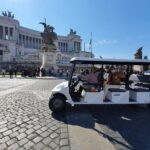
Piazza Venezia is dominated by the Vittorio Emanuele II Monument, often called the Altar of the Fatherland. It’s huge, formal, and very much a statement piece in the center of Rome.
You get 20 minutes at the piazza area, and the plan lists admission as free for this stop, with a key viewpoint from the terrace. The value here is the sightlines: you can connect Piazza Venezia to the wider “Ancient City” zone, with views toward the Roman Forum and the Colosseum.
This is one of the best stops for understanding Rome’s geography. Up high, the city stops feeling like a grid of disconnected attractions and starts feeling like a single continuous story.
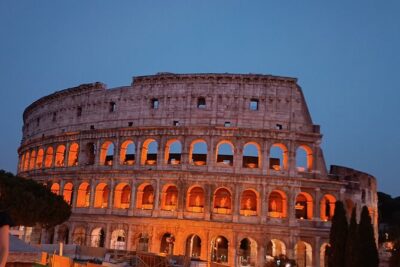
Colosseum area from the outside: a fast hit without entry
The Colosseum is the icon everyone recognizes, even if you’ve never studied a single date in your life. It once hosted gladiatorial battles, animal hunts, and public spectacles. Even with centuries of damage, its scale still hits hard.
Here you get a 20-minute stop, but the plan explicitly states entrance is not included. Admission is listed as not included, and the tour format notes you won’t go inside.
So what should you expect? You’ll see the Colosseum from the outside with time to photograph and absorb the size. This works if you want the highlight and you care more about finishing the day with multiple neighborhoods covered.
If your bucket list includes being inside, walking the corridors, and spending time at exhibits, you’ll want a different tour that matches that goal.
San Pietro in Vincoli: Moses, relics, and a quieter kind of wow
San Pietro in Vincoli is a smarter stop than it sounds on paper, mainly because it offers a different flavor of famous.
It’s best known for Michelangelo’s statue of Moses, which sits in the tomb of Pope Julius II. There is also a relic connected to Saint Peter’s chains, believed to have bound the apostle in prison.
You get 20 minutes here, and admission is listed as free. This is one of those places that often feels calmer than the headline attractions around it, which makes it easier to actually look and take in what you came for.
If your group likes art and symbolism, this church is a strong match. It is not just another big building; it’s built around a handful of major draws.
Giardino degli Aranci: a hilltop pause with skyline views
Giardino degli Aranci, also called the Orange Garden, is the day’s breathing moment. It’s a peaceful hilltop setting with orange trees and a view over Rome’s skyline.
You get 20 minutes, and admission is listed as free.
This stop is more than scenery. It’s where you recover your energy. After earlier monuments, you get a slower, gentler feel, and the hilltop layout also gives you a more layered perspective on Rome’s rooftops.
If you want photos that look less like tourist postcards and more like actual views, this is one of your best shots.
Circo Massimo and Terrazza del Pincio: big open space plus the best panoramas
Circo Massimo is where ancient Roman entertainment becomes open space. It was once the largest chariot racing stadium in ancient Rome, and today much of the original structure is gone.
You get 20 minutes, admission listed as free. The value here is not “what you can see up close,” but what the space tells you. You can walk and feel the scale of something that once drew huge crowds for spectacle.
Then comes Terrazza del Pincio, a panoramic favorite on the Pincio Hill. The plan lists another 20-minute stop, free admission. This viewpoint is especially good for photos around sunset, and even at other times it gives you classic angles toward Piazza del Popolo and the basilica area.
If your timing ends up closer to evening light, this is where you’ll be glad you didn’t skip this stop.
Pantheon neighborhood: a dome you recognize, seen outside
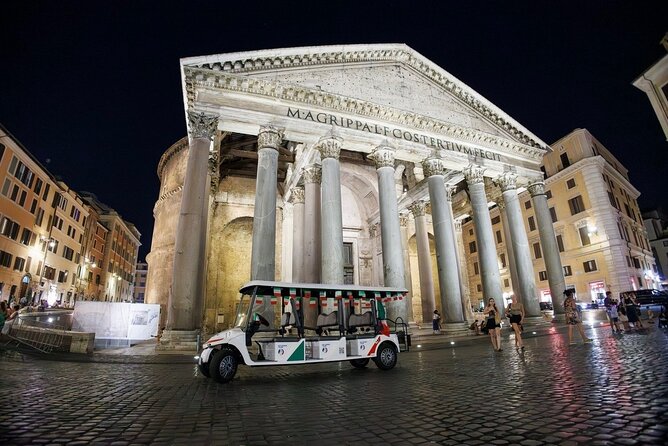
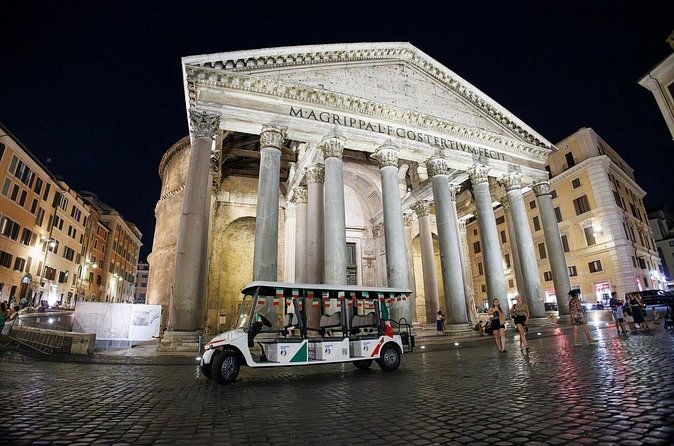
The Pantheon is famous for its massive dome and the central oculus that brings light into the interior. It’s one of the best-preserved monuments in Rome and has been around for nearly 2,000 years.
In this plan, Pantheon is a 20-minute stop, and admission is listed as not included. The tour format also notes no entry.
So you’ll be viewing from the outside. For most people, the exterior is still the main reason the Pantheon makes the list, and the “I can’t believe this is still here” feeling often hits just as well from the square and facade.
Just know: if you were counting on interior light and that exact architectural experience, this route won’t deliver it.
Santa Maria Sopra Minerva: Gothic church, Michelangelo details, Bernini’s funny sculpture
Santa Maria Sopra Minerva is described as the only Gothic church in Rome, and it includes big names attached to it. Inside, you’re looking at the tomb of Saint Catherine of Siena, and there’s a statue of Christ by Michelangelo.
Your stop is 20 minutes and admission is listed as free. The plan also calls out something memorable right outside: Bernini’s Elephant and Obelisk sculpture in the square nearby.
This is a great stop if your group likes clever connections between art and city corners. You’ll go from ancient-sounding titles to a very specific piece of public sculpture that feels playful in a city that can also be overwhelming.
Campo de’ Fiori to Piazza Navona: markets by day, party energy by night
Campo de’ Fiori is a lively square with a market by day and nightlife after. At the center stands a statue of Giordano Bruno, a philosopher burned at the stake for his controversial ideas.
You get 20 minutes and admission is free. Even if you’re not shopping, it’s a useful stop because it shows Rome as an everyday place, not only a museum.
Then Piazza Navona comes next, built on the site of an ancient Roman stadium. The main appeal here is the Baroque fountains, including Bernini’s Fountain of the Four Rivers. You’ll also get a street-life atmosphere with cafes and performers in the mix.
Another 20-minute stop and free admission.
The tradeoff with squares like these is crowd and noise. If your group hates busy places, you’ll want to treat these as quick photo-and-walk stops rather than long hangs.
Spanish Steps and Trevi Fountain: two icons that still work when time is short
The Spanish Steps connect Piazza di Spagna with the Trinità dei Monti church. The plan highlights the staircase’s 135 steps and describes the area as a meeting point surrounded by high-end boutiques. You’ll get 20 minutes and free admission.
Fontana di Trevi needs no introduction. You get another 20-minute stop with free admission.
These stops are classic because they’re always dramatic, but the format here is what makes them useful. You can still get the photo, the vibe, and a quick look at the surroundings without turning your day into a line-management exercise.
If you care about getting truly great photos, arrive ready to move your angle fast. These are popular spots, so the best shot is often the one you manage in the first minute.
Price for a private cart up to 7: is it good value?
The price is listed as $2,401.97 per group for up to 7 people, with about 6 hours on the calendar.
Here’s the value math in plain terms: this can be expensive if it’s just two people. It becomes more reasonable if you fill the cart with a group of friends or a family unit. Private transportation plus a guide who handles routing and timing can cut the friction that normally costs you time (and often energy).
So I’d weigh it this way:
- If you have 4 to 7 people, it can feel like a strong deal for a day that strings together many major stops.
- If you’re a solo traveler or a couple, it can still be worth it if your priority is maximum sight coverage with minimal walking, but you should compare it to other half-day or entry-focused options.
One more value point: the route keeps you moving. If your “cost” is time and exhaustion, not just dollars, this format can land well.
The guide can make or break the day
A standout theme from the experience feedback is the guide’s flexibility. The tour is run by Not Boring Tours, and one guide name that comes up is Domenico (credited as @notboringtours). People praise his fun, informative style and his Roman history knowledge, plus the fact that the tour can shift.
That matters because Rome is rarely predictable. If a stop feels less interesting to your group, you don’t have to power through it. If another monument hits harder than expected, you can put more weight on it.
This is the difference between a checklist tour and a day that feels like it fits you.
Who this tour suits best
This See Rome in a Day cart tour fits best if:
- You want to hit major highlights in one day.
- Your group includes people with different interests (one might love ruins, another loves viewpoints).
- You prefer short stops with photo time over long indoor visits.
- You’d rather spend your energy on seeing more Rome, not walking between distant corners.
It may not fit if:
- Your main goal is interior time at St. Peter’s Basilica, the Colosseum, or the Pantheon.
- You want a slow museum day with deep reading and long stays in one place.
Should you book this golf cart highlights tour?
If you’re short on time and your goal is coverage, this is a smart choice. The route strings together big names, terraces, and a few calmer breaks like the Orange Garden. With a private cart and the flexibility praised for Domenico and others, you have a good shot at ending the day feeling like you actually saw Rome, not just waited at curb corners.
Before booking, check your priorities: this plan is built around outside views and quick, efficient stops. If you’re dreaming of spending hours inside the Pantheon or standing in the Colosseum’s interior spaces, you’ll likely want a different style tour.
FAQ
What’s the duration of the tour?
It’s listed as approximately 6 hours.
What time does the tour start, and where does it meet?
The start time is 11:00 am, and the meeting point is Via Santamaura, 12, 00192 Roma RM, Italy. The tour ends back at the meeting point.
Is this a private tour?
Yes. It’s a private tour/activity, and only your group participates. The group size is up to 7.
Do we enter St. Peter’s Basilica, the Colosseum, or the Pantheon?
No. The tour information states you do not enter St. Peter’s Basilica, the Colosseum, or the Pantheon, and the stops are for viewing from outside.
Is the tour in English?
Yes, it’s offered in English.
What’s included, and what’s not included?
Included: private transportation. Not included: admission for the Colosseum and the Pantheon (and the tour notes no interior entry for those major stops). Admission details are listed for other stops as included or free.