REVIEW · ROME
Caravaggio Art Walking Tour of Rome with Pantheon Visit
Book on Viator →Operated by Nicom Tours · Bookable on Viator
Rome’s art world gets personal fast. This half-day Caravaggio walking tour takes you into the churches where his paintings still feel close and immediate, then finishes with a timed visit to the Pantheon. I especially like the mix of famous works and lesser-sung church settings, and I like that the group stays small (up to 15), so the guide can actually explain what you’re seeing.
One thing to think about: this is a walk with multiple church interiors, so wear comfortable shoes and plan for changeable weather around 4 pm. The time in each stop is well paced, but it means you’ll want to move with the group rather than linger for long photo marathons.
In This Review
- Quick hits before you go
- Why Caravaggio and the Pantheon is a smart pairing
- Meeting near Piazzale Flaminio and Piazza del Popolo
- Santa Maria del Popolo: where Caravaggio meets Raphael’s dome
- Campo Marzio stroll: Via Ripetta’s street-life context
- Santa Maria della Pace: Raphael frescoes and ceiling angels
- Sant’Agostino and the Madonna del Loreto in the Cavaletti Chapel
- Pantheon interior: conversion story and tombs of Italy’s kings
- The included aperitivo: a real break, not a rushed add-on
- Pacing, group size, and what to wear at 4 pm
- Is the $65.17 price fair value?
- Who this tour is best for
- Should you book this Caravaggio and Pantheon walking tour?
- FAQ
- FAQ
- What’s the duration of the tour?
- What time does the tour start?
- Where do we meet, and where does it end?
- What’s included in the price?
- Is Pantheon admission included?
- Which Caravaggio works will we see?
- How big are the groups?
- Is hotel pickup provided?
- Is luggage storage available?
- Can I get a full refund if I cancel?
Quick hits before you go
- Caravaggio in his intended settings: you see his paintings inside the churches they were made to belong to, not behind glass in a museum.
- Pantheon interior included: you don’t just view it from the outside—you go in and get the story.
- Aperitivo is built in: you get a wine-bar-style break, not an awkward end-of-tour scramble.
- Small-group feel: max 15 travelers and headsets help keep the experience focused.
- A late-afternoon route: you’re moving through Rome’s historic center starting at 4 pm, when the light can be great for street views and photos.
- Guides bring context, not just art facts: guides are praised for connecting paintings to Roman life and the wider historical story.
Why Caravaggio and the Pantheon is a smart pairing
Caravaggio and the Pantheon might look like two different worlds at first—one is baroque intensity in church chapels, the other is ancient Roman engineering that still feels modern. But that contrast is the point. You go from late-1500s Rome, shaped by ambition and conflict, to a building that literally re-used and re-interpreted older power.
You’ll also get a structure that makes the art easier to follow. The tour doesn’t treat the sites as disconnected stops. It layers themes as you walk: Caravaggio’s time in Rome, what he was responding to, and how later artists and patrons shaped what you see in these churches today. Then you land in the Pantheon, where the conversation shifts to Rome’s long arc—pagan temple to Christian landmark, plus the way Italian unification later reshaped who gets remembered there.
You can also read our reviews of more walking tours in Rome
Meeting near Piazzale Flaminio and Piazza del Popolo
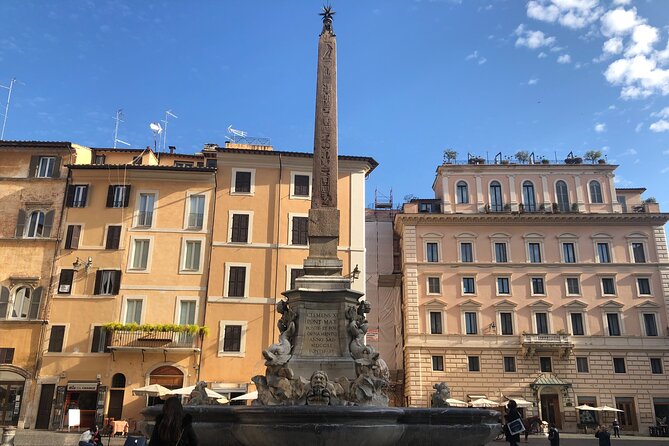
The tour starts at 4:00 pm, meeting near Piazzale Flaminio in Rome. In practice, you’re close to Piazza del Popolo, because that’s where the route begins and where you’ll likely get your first orientation.
This timing matters. Starting in late afternoon means you’ll be able to cover multiple sites without fighting the most intense morning crowds. It also means you should be ready for shifting conditions—one of the most common practical notes is that rain can hit while you’re between churches.
You’re also ending around Pantheon/Piazza della Rotonda, so you can easily continue on foot afterward. It’s a convenient “finish where Rome wants you to be.”
Santa Maria del Popolo: where Caravaggio meets Raphael’s dome
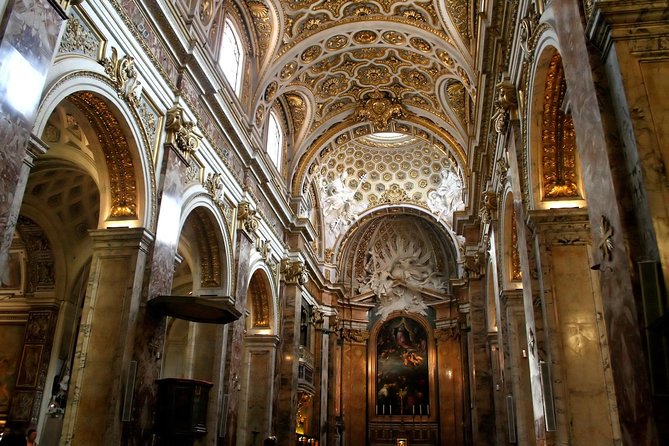
Your first stop is Chiesa di Santa Maria del Popolo, just off Piazza del Popolo. This is a big opener, because you’re going to see two Caravaggio works in the same church: Crucifixion of St. Peter and Conversion on the Way to Damascus.
This stop runs about 45 minutes, and admission is included. That matters because it prevents you from doing the usual Rome routine: standing around, figuring out ticket lines, then losing time you’d rather spend inside where the paintings live. It also means you can focus on the art itself with the guide’s explanations.
If you’re trying to understand Caravaggio’s impact in Rome, this is a strong place to start. You’re not just seeing subject matter—you’re seeing how patrons and church architecture frame his work. Also, the church has that dome designed and frescoed by Raphael, which gives you a ready-made contrast between two major visual languages you’ll keep running into around Rome.
Practical note: arrive ready to look up as well as straight ahead. The guide’s commentary here is often part of the reason this stop sticks—because the building and the painting are part of the same story.
Campo Marzio stroll: Via Ripetta’s street-life context
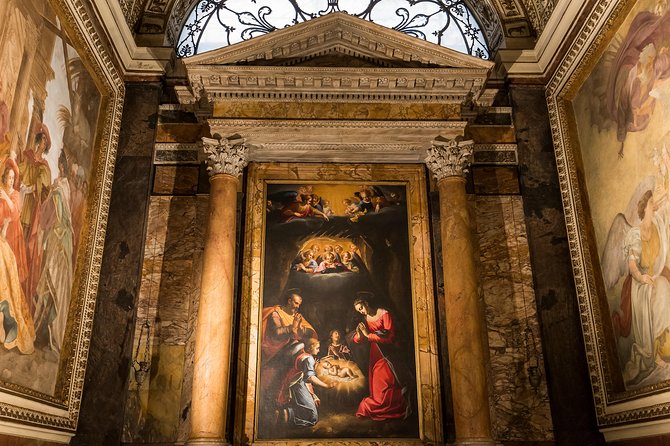
After Santa Maria del Popolo, you head into the Campo Marzio district, walking along Via Ripetta. This stretch is lighter on ticketed entry and more about atmosphere and context, and it’s described as free admission for this segment.
You’ll hear a very specific idea tied to Caravaggio: that he drew inspiration from the street life of the area, including the large number of prostitutes who inhabited Via Ripetta. Whether you come at this from art history, sociology, or just curiosity, that kind of grounding helps you understand the world behind the paintings.
This is also where you learn something Rome does well—how neighborhoods carry memory without announcing it. A short walk here can make the later church stops feel less like random masterpieces and more like responses to real surroundings.
Santa Maria della Pace: Raphael frescoes and ceiling angels
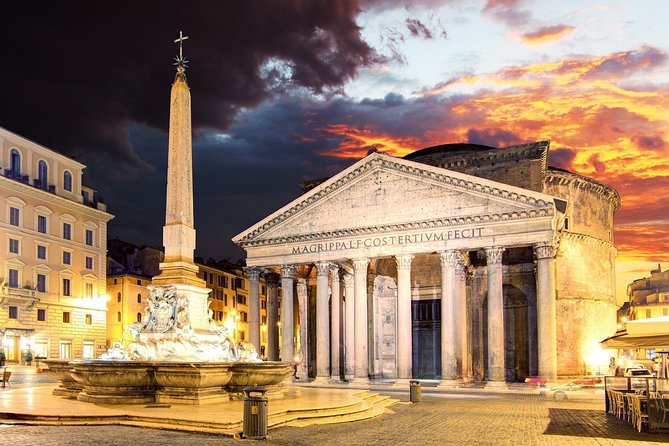
Next you visit Chiesa di Santa Maria della Pace, with about 30 minutes on the clock and admission included. Here, you’ll look at Raphael’s fresco of Sybil’s dance, plus the ceiling angels described in the tour.
This stop is valuable because it gives you a second anchor point for Raphael, separate from the earlier Raphael dome. It’s a quick way to see how both artists shaped religious spaces—through different emphases and different visual storytelling.
It’s also a breather. Compared to your first stop’s intensity, this one tends to feel like a calmer change of pace while still feeding your understanding. If your brain gets overloaded after too many masterpieces in a row, this is the moment where things can feel more navigable.

Sant’Agostino and the Madonna del Loreto in the Cavaletti Chapel
Now you move to Sant’Agostino, another important church on the route, with about 30 minutes. Admission is listed as free for this segment.
This stop combines two strong threads:
- You’ll see work linked to Caravaggio, including Madonna del Loreto, housed in the Cavaletti Chapel.
- You’ll also admire Raphael work inside Sant’Agostino.
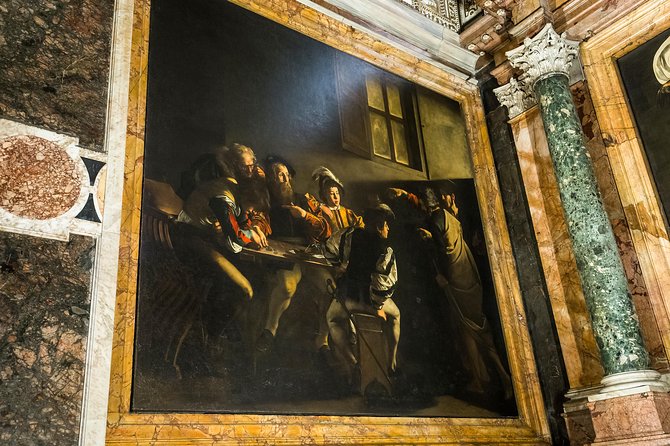
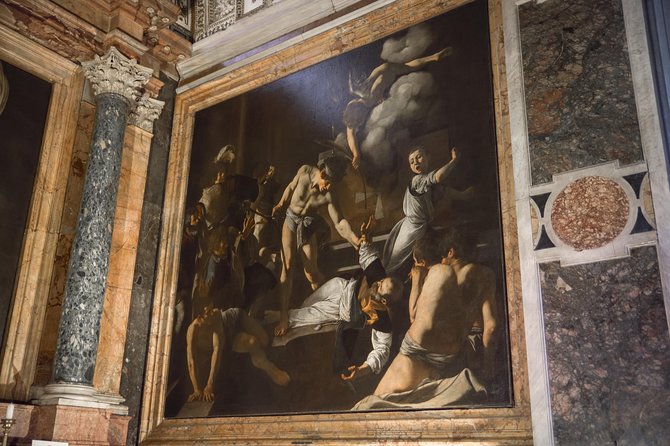
Then the tour narrative connects forward to San Luigi dei Francesi, where a Caravaggio trilogy dedicated to San Matteo is kept. The tour description frames the artist’s life as non-conformist and marked by persecution, leading to his early and tragic death. Even if you don’t leave this stop “seeing everything” there, the guide’s connection matters. It helps you understand that Caravaggio’s career wasn’t just artistic—it was personal, risky, and tangled with power.
If you care about why people painted what they painted, this is one of the most satisfying parts of the walk. You’re not just collecting titles. You’re being guided through the cause-and-effect logic between life experience, religious commissions, and the environments where paintings end up.
Pantheon interior: conversion story and tombs of Italy’s kings
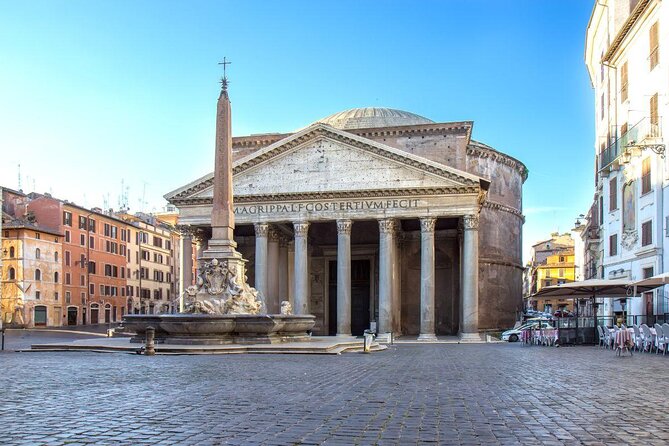
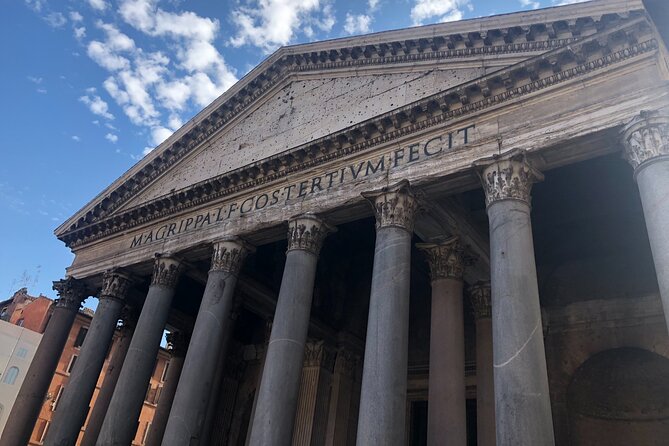
The final stop is the Pantheon, with about 30 minutes and admission included. You’ll go inside to see the interior, and you’ll get the key historical storyline: it was the first pagan temple converted to Christianity.
This is also where the tour offers a uniquely Italian layer. Today, the Pantheon is home to the tombs of the first two kings of Italy, placed there after unification in 1861. Between them, you’ll also find the tomb of Raphael, whose work is described as a model of perfection in Renaissance painting.
This matters for your experience because it turns the Pantheon from a “cool ancient building” into a place where Rome keeps updating who is honored. It’s not just old stone. It’s an active memory site, still part of Italy’s cultural identity.
If you’re trying to decide which big Roman landmark to prioritize, this stop helps. You get both architecture and story, plus a finishing point that’s easy to branch out from afterward.
The included aperitivo: a real break, not a rushed add-on
One of the best parts of the tour package is that you don’t end completely empty. The tour includes aperitivo at a local wine bar, described as a refuel stop included in the experience.
In guides’ hands, this often becomes a chance to relax while the day’s art themes fade into conversation. Several named guide experiences are tied to this portion—people praise the wine-bar side as well as the small bite. Some groups also specifically call out a stop at a place like Casa Coppelle for prosecco and wine with food that feels like a proper light meal rather than a vending-machine snack.
What to expect: you’re finishing your church-and-architecture day with something social, but not a party. It’s a good way to keep the day from turning into pure sightseeing fatigue.
Pacing, group size, and what to wear at 4 pm
This is a 3-hour tour with a small group of up to 15 people, and you’ll have headsets. That combination is practical. Churches can be echoey, streets can be noisy, and a guide’s clarity matters when you’re trying to follow names and details.
The route also has a built-in rhythm: a longer first entry (Santa Maria del Popolo), then shorter church time blocks, then the Pantheon. Most stops are about 30 to 45 minutes. That’s long enough for the guide’s story to land, but short enough that you won’t get stuck in one place for an hour and a half.
Wear comfortable shoes. One practical caution that comes up is that weather can shift, and you might spend time standing outside between sites while the guide talks. Bring a light rain layer if there’s any chance of showers.
Also note: there’s no luggage storage. If you’re traveling with bags, plan your day so you’re not stuck carrying everything to church interiors and then searching for storage.
Is the $65.17 price fair value?
At $65.17 per person for about 3 hours, the value comes from what’s bundled, not just the guide.
Here’s what you’re getting as part of the experience:
- Expert local guide
- Headsets
- Pantheon interior visit
- Aperitivo
- Admission tickets listed as included for some stops (like Santa Maria del Popolo and the Pantheon) while other stops are free
For Rome, where ticketing can add up quickly and time lost to lines can be painful, bundling the key interior visits is the real win. You’re paying for a guided route that already handles the high-friction parts of the day—entry to major sites and the story you’d otherwise piece together yourself.
And the small-group cap matters. A group of 15 is still big enough to meet people, but small enough that your guide can keep moving at a human pace and explain what matters at each church.
Who this tour is best for
This is a great fit if:
- You like art in context, not just art as a checklist.
- You want a church-focused route that includes both big names and specific Caravaggio works.
- You’d enjoy hearing how Rome’s history connects to what ended up on church walls.
- You want a half-day plan that still leaves energy for dinner.
It may be less ideal if:
- You hate walking or are expecting a mostly indoor, low-step plan.
- You need long stays in fewer locations. Here, the pacing is efficient. That’s usually a plus, but it’s not built for slow wandering.
Should you book this Caravaggio and Pantheon walking tour?
Book it if you want a strong art route with real emotional weight—Caravaggio in churches, plus the Pantheon as a spectacular architectural finish—and you like having a guide connect the dots as you go. The small group size, headsets, and included aperitivo make it feel like a complete afternoon, not just a ticket to a couple churches.
Skip it only if you’re very sensitive to wet weather or you’re hoping for a low-walking, museum-style day. Otherwise, this is a smart way to spend Rome time: you see the paintings where they belong, then you close with one of the city’s most important interiors.
FAQ
FAQ
What’s the duration of the tour?
The tour is about 3 hours.
What time does the tour start?
The start time is 4:00 pm.
Where do we meet, and where does it end?
You meet near Piazzale Flaminio, Roma RM and the tour ends at the Pantheon area (Piazza della Rotonda, 00186 Roma RM).
What’s included in the price?
The tour includes the Pantheon internal visit, an expert local guide, headsets, and aperitivo.
Is Pantheon admission included?
Yes, the Pantheon interior is included.
Which Caravaggio works will we see?
In Santa Maria del Popolo, you’ll see Crucifixion of St. Peter and Conversion on the Way to Damascus. In Sant’Agostino, you’ll see Madonna del Loreto (in the Cavaletti Chapel).
How big are the groups?
The tour has a maximum of 15 travelers.
Is hotel pickup provided?
No, hotel pickup and drop-off are not included.
Is luggage storage available?
No, luggage storage is not available.
Can I get a full refund if I cancel?
Yes. You can cancel up to 24 hours in advance for a full refund.