REVIEW · ROME
Rome Golf Cart Tour: Highlights of the Eternal City
Book on Viator →Operated by ROME GOLF CART TOUR · Bookable on Viator
Rome is easier when you ride.
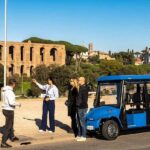
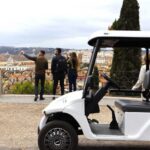
This 3-hour private golf cart or eFiat tour strings together Rome’s best-known sights with calmer backstreets, so you spend less time stuck and more time seeing. It’s built for real-world sightseeing: multiple departure times, quick photo stops, and a driver who can keep the story moving as you roll through the city.
I really like the free hotel pickup from central Rome, because it removes the first stress of a “where do we meet” day. I also like that the route mixes crowd magnets with places that feel more local, including Campo de’ Fiori and the ancient zones around the Seven Hills.
One thing to think about: the big sights get short windows. For example, Pantheon is listed at 15 minutes and Trevi Fountain at 10 minutes, so you get an efficient overview, not a slow, linger-at-every-corner kind of day.
In This Review
- Key highlights worth caring about
- Why a golf cart (or eFiat) makes sense for first-time Rome
- Pickup, meeting point, and how the day actually starts
- The opening run: Pantheon and Piazza Navona in a tight, efficient loop
- Trevi Fountain and Spanish Steps: quick stops for big impact
- Campo de’ Fiori: where the city feels more lived-in
- Villa Borghese and Palatine Hill: swapping crowds for context
- Circo Massimo and the Seven Hills: ancient Rome comes back fast
- Piazza del Popolo and Sant’Ignazio di Loyola: the finish feels different
- What the best guides tend to do with this tour
- Comfort, timing, and the reality of short stops
- Price and value: when $163.26 per person feels fair
- Who this Rome golf cart tour is best for
- Should you book this Rome golf cart tour?
- FAQ
- How long is the Rome golf cart tour?
- What does the price include?
- Do I need to buy entry tickets?
- Is lunch included?
- Will there be pickup from my hotel?
- Is this tour private?
- What language is the tour offered in?
- Can I cancel for free?
- Is the meeting point near public transportation?
Key highlights worth caring about
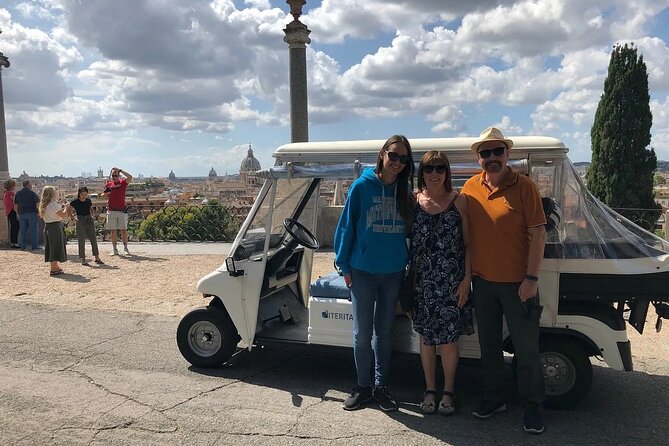
- Hotel pickup in central Rome to start your tour already rolling
- Private cart experience so your group sets the pace
- Quieter backstreets to reduce traffic stress
- Major icons plus ancient Rome in just about 3 hours
- Short, focused stops that work if you’re time-crunched
- English-speaking driver for smoother navigation and context
Why a golf cart (or eFiat) makes sense for first-time Rome
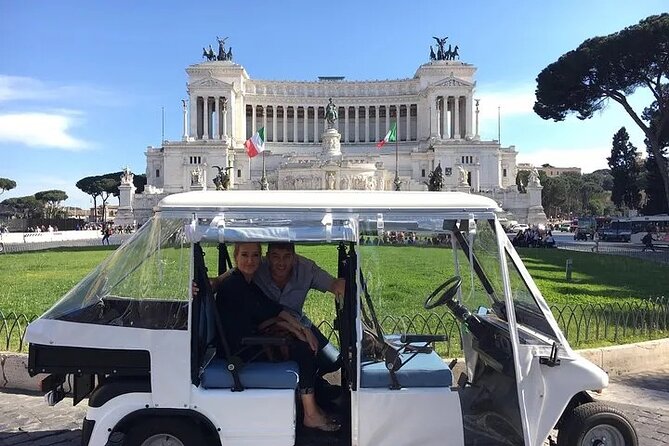
Rome can feel like two cities at once: the postcard Rome and the traffic-and-cobblestones Rome. A golf cart tour is a practical compromise. You still see the landmarks, but you cover ground with far less walking fatigue.
You’re also moving through areas you might not automatically choose on your own. The tour is designed to route you along quieter backstreets, which matters because Rome’s main lanes can be a slog. Even on a rain day, the format keeps the day flowing, since you’re not relying on long stretches outdoors.
And yes, the city is bumpy. One guest specifically called out how serious the cobblestones are, which is a good heads-up. The cart helps, but you should still expect that Rome won’t feel like a smooth highway ride.
You can also read our reviews of more city tours in Rome
Pickup, meeting point, and how the day actually starts
Your day begins either with hotel pickup (if you’re in central Rome) or at the meeting point in Rome at Pic Nic – Just Amir srl (Piazzale delle Canestre, SNC, 00197 Roma). The tour is set up so it’s easy to jump in without playing transport Tetris all morning.
If you’re not staying in Rome center, you’re told to contact the operator and a private car might be arranged. That’s important because it protects the value of the tour. The whole point is convenience, and it only works if you’re not spending an hour figuring out how to reach the starting point.
You’ll also get a mobile ticket, and there are numerous departure times, which is great if your schedule is tight. Most people can participate, and it’s a private tour/activity, meaning only your group rides.
The opening run: Pantheon and Piazza Navona in a tight, efficient loop
Stop 1 is the Pantheon. You get about 15 minutes, and admission is listed as free. The Pantheon is described as a former Roman temple that became a Catholic church in 609 AD, built on an earlier temple commissioned by Marcus Agrippa during Augustus’s reign. In other words, this is where Rome’s layers show up instantly.
Stop 2 is Piazza Navona, around 15 minutes with free admission listed. It’s described as a spectacular Baroque square built on the remains of the Stadium of Domitian. This stop works well early in the tour because it helps you reframe what Rome is: not just ruins, but places where people still gather.
What makes this opening run smart is pacing. You’re not asked to “choose” between icons or neighborhoods. You get both within the first hour, with the cart doing the heavy lifting while the guide handles the connections.
Trevi Fountain and Spanish Steps: quick stops for big impact
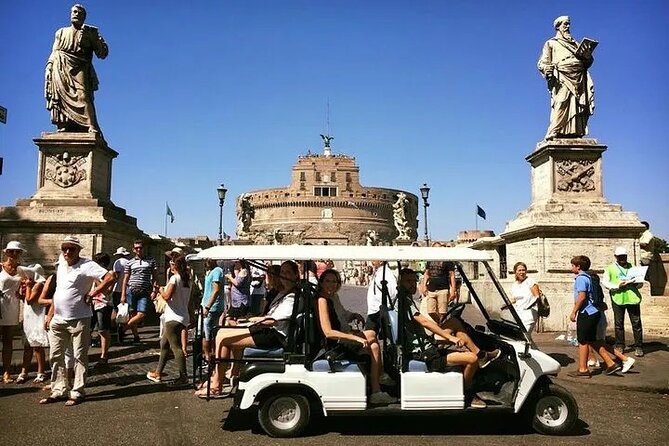
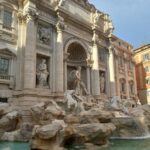
Next comes Trevi Fountain, listed at about 10 minutes with free admission listed. It’s an 18th-century fountain in the Trevi district, designed by Nicola Salvi and completed by Giuseppe Pannini and others. This is one of those places where a short stop can still be worthwhile if you’re using it for the right job: photos, orientation, and a clear sense of where it sits in the city.
Then you roll to the Spanish Steps, about 5 minutes with free admission listed. The Spanish Steps climb between Piazza di Spagna and Piazza Trinità dei Monti, dominated by the Trinità dei Monti church at the top. This is a classic “see it once, then come back later” sight, and the cart format makes that strategy easier.
Here’s the practical tradeoff: the tour doesn’t try to turn Trevi and the Spanish Steps into a long visit. If you want an hour of quiet, this isn’t that. But if you want to check these off while still seeing other parts of Rome, these short windows are exactly the point.
Campo de’ Fiori: where the city feels more lived-in
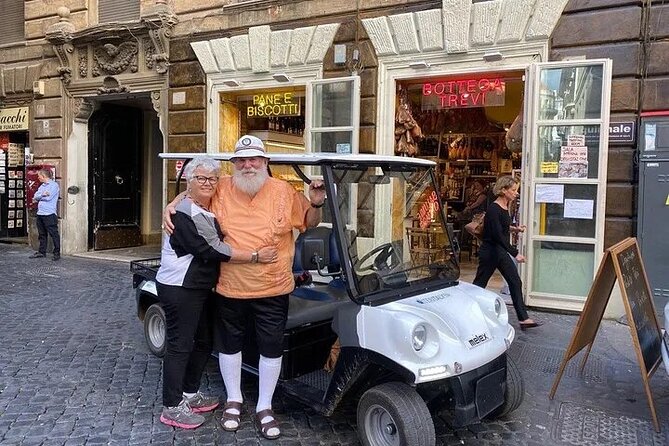
Stop 5 is Campo de’ Fiori, listed at about 5 minutes and free admission. It’s described as full of color and sound and as one of the souls of Rome. The center of the piazza overlooks the statue of philosopher Giordano Bruno, burned alive in the center of the piazza.
This is one of the stops where I think a cart tour can surprise you. It’s not just a famous name. It’s a place that feels like it belongs to day-to-day Rome, and it breaks up the “big museum moments” with something more street-level.
Because you only get a few minutes here, treat it like a spark. Take a photo, look around, and use it as a launch point for what you’d explore on your own later.



Villa Borghese and Palatine Hill: swapping crowds for context
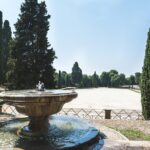
After the piazzas, you move into greener and older-feeling Rome. Villa Borghese is next, described as a landscape garden with buildings, museums, and attractions. It’s identified as the third largest public park in Rome.
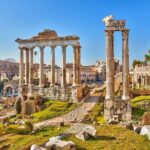
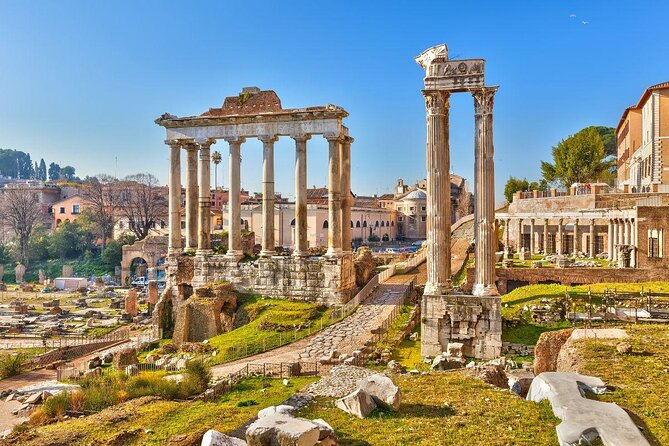
Then comes Palatine Hill, described as the centremost of the seven hills of Rome and called the first nucleus of the Roman Empire. This is a powerful pairing with Villa Borghese because it helps you feel the “where Rome began” part, not just the “where Rome became a tourist brand” part.
Even without long museum time, these stops do something valuable. They give you mental geography. Later, when you’re walking on your own, you’ll have a better sense of where you are in relation to the old core of the city.
Circo Massimo and the Seven Hills: ancient Rome comes back fast
Next is Circo Massimo, around 5 minutes with free admission listed. It’s described as an ancient Roman chariot-racing stadium and mass entertainment venue. It’s noted as the first and largest stadium in ancient Rome and later the Empire.
Then you’re at the Aventine Hill, one of the Seven Hills. The tour data notes it belongs to the modern twelfth rione of Rome (Ripa). This is one of those places where the cart helps because you can see the bigger picture without committing to a long walk uphill.
If you’re trying to understand Rome quickly, this section is key. You move from piazzas into massive ancient spaces, and you get a sense of scale even during a short stop.
Piazza del Popolo and Sant’Ignazio di Loyola: the finish feels different
Stop 7 is Piazza del Popolo, about 5 minutes with free admission listed. It’s located inside the northern gate of the city, once called Porta Flaminia, and its name means The People’s Square. This is a good way to end with a recognizable civic space, which helps you bring your mental map back into focus.
Finally, you visit Chiesa di Sant’Ignazio di Loyola, listed at about 5 minutes with free admission. This church is described in detail: it was built based on a design by Jesuit mathematician Orazio Grassi, using plans by Carlo Maderno and others, and funded by Cardinal Ludovico Ludovisi, nephew of Gregorio XV. The facade inspiration is tied to the nearby church of Gesù, including two orders of pilasters and Corinthian columns, plus windows and niches.
This last stop can feel like a bonus because it’s not one of the usual “every first-time visitor must do” targets. It adds variety: instead of only outdoor landmarks, you get a refined look at a specific church’s design story in a short time window.
What the best guides tend to do with this tour
This kind of tour works or fails based on how the guide manages the flow. When guides like Francesco and Yvonna are at the helm, the day can feel like a guided story instead of a checklist. Multiple guide names show up in the experience set, including Hadi, Mario, Claudio, Ivanna, and Pietro, and the common thread is clear communication plus keeping the tour fun.
A few guide details that matter for you:
- You want someone who doesn’t just point. The guides praised in the provided information are described as polite, flexible, and invested in answering questions.
- If you’re in Rome for the first time, a guide who can suggest practical extras can be a real upgrade. One guest credited Francesco with dinner and additional site ideas beyond the tour route.
- If you’re traveling with limited mobility or a small child, you’ll likely value a guide who helps the day feel easy and not rushed. The golf cart format already does this, and the best guides make it feel even smoother.
If you get a guide who’s engaged, your 3 hours can feel like you’re learning the city’s logic, not just driving past landmarks.
Comfort, timing, and the reality of short stops
The comfort piece is big. A golf cart tour is often chosen because it’s less tiring than long walks between scattered highlights, especially in summer heat or when you’re trying to see a lot in limited time.
That said, Rome isn’t designed for perfect comfort. Expect cobblestones and uneven surfaces. One guest noted that other carts lacked seatbelts in their experience, while this particular tour had seatbelts. I’d still suggest you ask what safety features your specific cart has when you check in.
Timing is also a balancing act. Many stops are listed around 5 to 15 minutes, with Pantheon at 15 and Trevi at 10. That’s enough for photos and context, but not enough for a slow, detailed visit. If you’re the type who likes to linger in one place for half a day, plan to return later on your own.
Price and value: when $163.26 per person feels fair
At $163.26 per person for about 3 hours, the value depends on what you want your Rome day to do.
This tour usually makes sense if:
- You’re time-crunched and want a fast orientation.
- You don’t want to spend your energy climbing between distant sites.
- You want a private setup, meaning only your group rides and you’re not stuck with strangers’ pacing.
- You’d rather pay for convenience than piece together multiple taxis and walking loops.
It’s also helpful to look at what’s and isn’t included. The tour does not include entry tickets and lunch. However, the stop list you’ll visit includes several locations marked as free admission (like Pantheon, Piazza Navona, Trevi Fountain, and several others). That means you’re less likely to feel “nickel-and-dimed” by add-ons during the drive, but you should still budget for any extras you choose later.
One more value lever: it’s set up with free pickup for central hotel guests in a private experience. That’s often the cost killer on tours like this, and it can make the price feel more reasonable.
Who this Rome golf cart tour is best for
This works especially well for:
- First-time Rome visitors who want a clear overview quickly.
- Couples and friend groups who want to see multiple sights without long walking days.
- Families who want an easier route through big-name areas.
- Anyone who wants the flexibility of a private group and doesn’t want to manage logistics on their own.
It may feel less ideal if you:
- Want museum-style time at fewer stops.
- Prefer self-guided wandering without short timed interruptions.
- Plan to spend the whole day at a single place and go deep with it.
Should you book this Rome golf cart tour?
If your goal is to see a lot in a short time and get your bearings without making Rome’s streets your full-time workout, I’d book it. The private setup, English-speaking driver, and hotel pickup help you start fast and finish without stress.
I’d also book it if you know you’ll come back to Rome at least once more. This tour is great for building your map, your must-see list, and your personal favorites for later.
If you hate short stops and you’re hoping for long museum time, skip it and plan a slower, more focused day instead. For everyone else, this is one of the easiest ways to get an overview of Rome that still feels like more than just driving past the scenery.
FAQ
How long is the Rome golf cart tour?
The tour lasts about 3 hours.
What does the price include?
The price includes a private tour experience with an English-speaking driver, and free hotel pickup is offered for a private experience.
Do I need to buy entry tickets?
Entry tickets are not included. The stops in the tour plan are listed with free admission in the provided details, but you should still plan for the general possibility of other ticket needs at places you add on.
Is lunch included?
No, lunch is not included.
Will there be pickup from my hotel?
Yes, free hotel pickup is offered if you’re on a private experience, and it’s described as being from central Rome.
Is this tour private?
Yes. It’s a private tour/activity, and only your group participates.
What language is the tour offered in?
The driver is listed as offering English.
Can I cancel for free?
Yes. You can cancel for a full refund up to 24 hours in advance. If you cancel less than 24 hours before the start time, the amount paid is not refunded.
Is the meeting point near public transportation?
The provided details say it is near public transportation, and the tour start is at Pic Nic – Just Amir srl in Rome, with the tour ending back at the meeting point.