REVIEW · LISBON
Authentic Lisbon: 4h Tuk Tuk Tour of Lisbon and Belém Secret Gems
Book on Viator →Operated by Local 100% Electric Tuk Tuk Tours · Bookable on Viator
Lisbon on a silent electric tuk tuk feels smart. This 4-hour ride strings together old-neighborhood character and Belém landmarks, with stops that work well on foot and from viewpoints. I really like how the route balances Alfama’s maze with Belém’s Age of Discovery monuments, plus the guide adds helpful local context along the way, often pointing out photo angles.
I also like the flexibility built into the experience: it’s private for your group and happens at a pace where you’re not constantly stuck in traffic or waiting for stragglers. And because the vehicle is electric and easy to hop on and off, you spend more time looking up at tiles, façades, and river views instead of walking across the whole city.
One consideration: admission isn’t included for several big Belém sights (like the Jerónimos Monastery and Tower of Belém), so you’ll want to plan a bit of extra time and budget if you want full inside visits at every stop.
In This Review
- Key things you should know before you go
- A route that actually saves your energy: Lisbon to Belém in 4 hours
- Starting at Praça do Rossio: getting oriented fast
- Stop 1: Miradouro da Graça for Lisbon’s “first look”
- Stop 2: Alfama’s lanes where you actually get lost (on purpose)
- Stop 3: Padrão dos Descobrimentos and the river perspective
- Stop 4: Jerónimos Monastery (Mosteiro dos Jerónimos) and Manueline wow
- Stop 5: Escadinhas de São Cristóvão and Mouraria’s feel
- Stop 6: Torre de Belém for the postcard-meets-real viewpoint
- Stop 7: Capela de Santo Amaro for azulejo-covered quiet
- Stop 8: Ponte 25 de Abril for the big red-bridge moment
- Price and value: what $144.49 buys you (and what it doesn’t)
- Who should book this tuk tuk tour
- Weather matters more than you think
- Should you book it? My quick decision rule
- FAQ
- How long is the tuk tuk tour?
- What does it cost?
- Where does the tour start and end?
- Is the tour private, and what language is it offered in?
- Are admission tickets included for the big Belém monuments?
- Which stops have free admission?
- What happens if the weather is bad or I need to cancel?
Key things you should know before you go
- Electric tuk tuk transport helps you cover steep and spread-out areas without burning your legs
- Private group experience means the route can feel more tailored to your pace
- Great viewpoint stacking: Graça overlook, Belém riverfront, and the 25 de Abril bridge area
- Mix of walk and ride: short strolls through traditional streets and curated photo stops
- Some entrances cost extra at major Belém monuments (plan ahead)
- Rui (and sometimes his brother) is the vibe: friendly, local, and strong on photo pointers and Lisbon context
A route that actually saves your energy: Lisbon to Belém in 4 hours
Lisbon is gorgeous, but it’s also hilly and tightly packed. That’s where an electric tuk tuk tour shines. In a short window, you get pulled between neighborhoods and landmarks that would take a lot longer by foot or public transit.
This particular tour is built for maximum sight time without turning into a sprint. You start near Rossio Square and finish back near the meeting point. The stops are spread to give you variety: traditional Lisbon lanes first, then Belém’s river monuments and viewpoints.
Another practical win: the tour is offered in English, and it’s designed for most travelers. If you’re traveling with limited mobility or just want less uphill walking, you’ll likely appreciate the “ride, then walk a little” rhythm.
And if your main goal is photos, you’re set up well. The route naturally hits spots where you can step out, frame the city, and look for the Tagus River and Lisbon rooftops from above.
You can also read our reviews of more tours and experiences in Lisbon.

Starting at Praça do Rossio: getting oriented fast
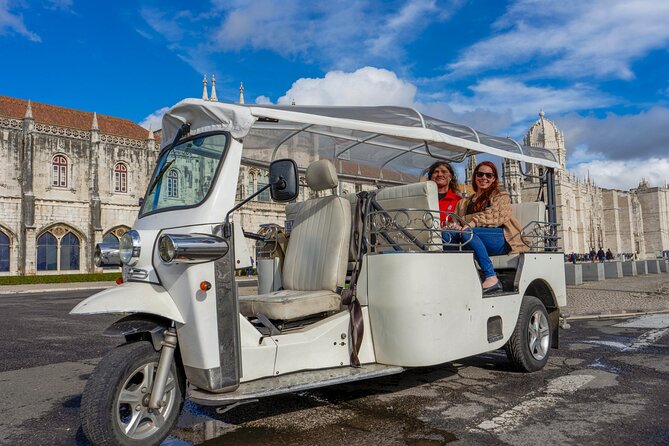
You meet at Praça do Rossio (Rossio Square). This matters more than it sounds, because it’s a central starting point and a familiar reference point for getting your bearings. If this is your first day in Lisbon, you’ll feel less lost right away.
From Rossio, the tuk tuk route quickly moves you away from the main drag and into older, more local-feeling streets. That transition is one of the reasons tuk tuk tours work so well here: you don’t have to fight your way through every busy block before you reach the good views.
Stop 1: Miradouro da Graça for Lisbon’s “first look”
Your first stop is Miradouro da Graça (Sophia de Mello Breyner Andresen). It’s a classic Lisbon viewpoint for a reason. This is where you start seeing how the city layers itself—rooftops, hills, and the sense of scale that makes Lisbon feel cinematic.
Bairro da Graça is traditional and still feels lived-in. You get a taste of that without it being so far out that you waste time getting there. The stop time here is about 30 minutes, and admission is free.
I like this as a warm-up stop. You’re not yet rushing into the densest streets. Instead, you get a “big picture” moment first, then the rest of the route makes more sense when you’re walking later.
Potential drawback: viewpoints can be popular. If it’s crowded, you may spend part of the 30 minutes just finding a spot to stand comfortably. Still, that time is usually worth it.
Stop 2: Alfama’s lanes where you actually get lost (on purpose)

Next up is Alfama, one of Lisbon’s oldest neighborhoods. The vibe here is different from the more polished tourist zones. You’ll notice the architecture—old, colorful buildings and narrow passages that feel like little corridors, not roads.
You’ll also get that classic Alfama experience: walking lanes where the city feels close to you. Some streets are cluttered in a charming way, and you can hear everyday neighborhood life as you pass. Even if you don’t know Portuguese, you’ll feel the rhythm of the place.
This stop is also about 30 minutes, and there’s no admission ticket needed for just wandering the area. In a tour like this, the goal isn’t to “check off” Alfama with a single photo. It’s to spend enough time that you can turn corners and notice details—doorways, tiles, staircases, and that constant sense of views popping into frame.
One consideration: Alfama streets can be uneven and tight. If you’re prone to rushing or have balance issues, go slower during the walking portion.
Stop 3: Padrão dos Descobrimentos and the river perspective
Then you shift toward Belém for Padrão dos Descobrimentos, the Monument to the Discoveries. It’s a bold, recognizable landmark on the riverfront, shaped like a stylized caravel and decorated with historical figures tied to Portugal’s Age of Discovery.
The stop is about 30 minutes. Admission for the monument is not included, so if you want to go inside or up for views, plan on paying separately.
From here, the best value is perspective. You look out over the Tagus River and see how Belém’s monuments line up along the water. This is also the kind of stop where photo help matters. In feedback from the operator’s guides, Rui has used a drone and also works with DSLR-style photo guidance at key viewpoints—so even if you’re not a photographer, you might get tips that turn casual shots into keepers.
Possible drawback: if you want to do everything at this stop and also keep the rest of the route on time, you’ll need to move efficiently. The monument’s paid access can add time.




Stop 4: Jerónimos Monastery (Mosteiro dos Jerónimos) and Manueline wow

After Padrão comes the big one: Mosteiro dos Jerónimos. This is one of Portugal’s signature sights and a UNESCO World Heritage monument. It’s tied to the Age of Discovery and the Portuguese return from India, and the building style here is the star—Manueline detailing carved in stone.
Your stop time is around 30 minutes, and again, admission is not included. That means the tour gives you time to experience the monument area, but the “full inside visit” depends on your pace and whether you decide to pay for entry.
Here’s how to make this stop worth it: if you’re short on time, focus on the most iconic parts visually and don’t let yourself get stuck reading every wall label. You’ll still get the main effect—scale, stonework, and the sense that Belém was built to impress.
Potential drawback: Jerónimos can be busy. If you hit it at peak times, you’ll want to keep moving steadily so you can still enjoy the architecture instead of waiting in lines.
Stop 5: Escadinhas de São Cristóvão and Mouraria’s feel

You then shift into Mouraria, a traditional and multicultural Lisbon neighborhood. The tour stop is Escadinhas de São Cristóvão, and it’s timed around 30 minutes with free admission.
This part of the route is valuable because it breaks up the Belém monument intensity. Mouraria is where you can feel Lisbon as a living neighborhood—people, street corners, and a different kind of architecture and street life than the riverfront.
If you like neighborhoods more than monuments, this stop punches above its weight. It also gives you a chance to reset after the heavier historical sites and get some street-level texture back into your day.
One consideration: because it’s a neighborhood street experience, it’s less “one exact photo spot.” You get value by wandering a bit and letting the streets do the work.
Stop 6: Torre de Belém for the postcard-meets-real viewpoint

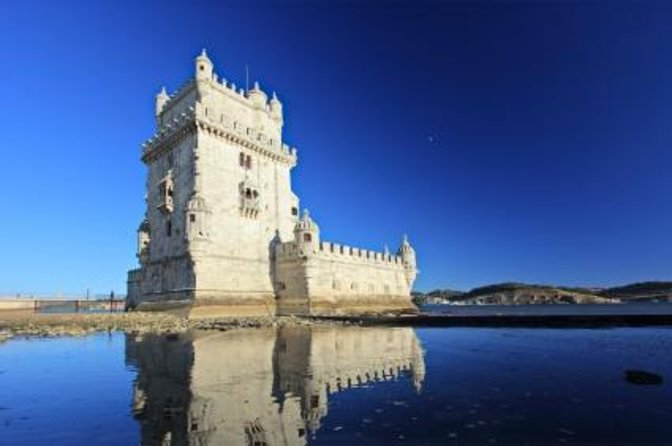
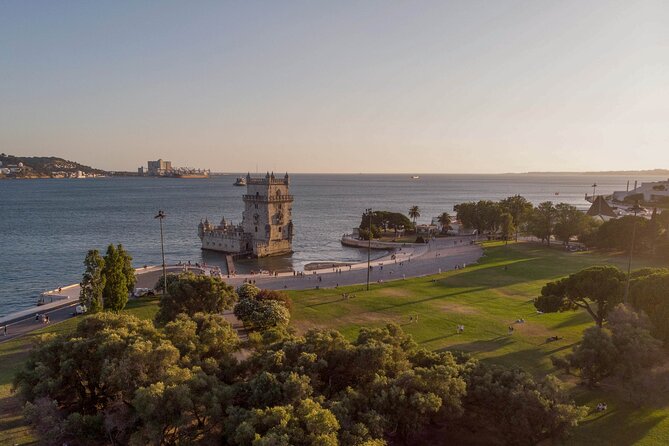
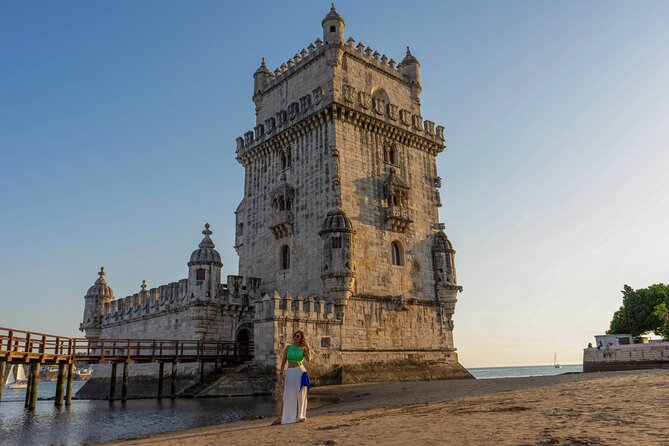
Next is the Torre de Belém (Belém Tower). It’s another UNESCO World Heritage icon and mixes Manueline and Gothic elements. The tower was built to defend the entrance to Lisbon’s port, and over time it also served other roles, which adds layers to what you’re seeing even from the outside.
The stop is about 30 minutes, and admission is not included. So you’re most likely doing an outside-focused visit unless you choose to add paid entry.
This is a great point in the tour to slow down. Look at how the tower sits relative to the river, and how the city frames it. The visual is one of the most recognizable in Portugal, but it’s still worth seeing in person because the tower’s position matters—you feel the river connection.
Potential drawback: if your main priority is interior views or climbing, you’ll need to decide early. The paid entry detail changes how fast you should move so you don’t feel rushed later.
Stop 7: Capela de Santo Amaro for azulejo-covered quiet
After the big riverfront hits, you get a smaller architectural treat: Capela de Santo Amaro. It’s described as a 16th-century architectural jewel with a richly decorated interior.
The standout feature here is the interior covering—polychrome azulejos that include scenes connected to Santo Amaro. That means you’re not just looking at a chapel as a building; you’re absorbing the story told in tile.
This stop is about 30 minutes and free admission. Also, it sits on a hill in Alcântara, which is a bonus because it can offer privileged views over the Tagus and the Ponte 25 de Abril area.
This is one of the stops I’d call “high reward for low friction.” You can get artsy, quiet, and scenic in the same block of time.
Potential drawback: tile-heavy interiors are photo-friendly, but lighting can be tricky. If you’re photographing, keep your expectations realistic indoors.
Stop 8: Ponte 25 de Abril for the big red-bridge moment
Last, you head to Ponte 25 de Abril. It’s a suspended bridge connecting Lisbon to Almada over the Tagus. It’s about 2,277 meters long with a central span over a kilometer, and it’s visually iconic—red-orange paint, elegant metal structure, and strong Golden Gate Bridge comparisons.
The stop is about 30 minutes with free admission. You’re not paying to see it, which is great because it’s the kind of landmark where the best part is watching the bridge in context: water, city edges, and the way the structure dominates the horizon.
Also, it’s an interesting historical note for your day. The bridge was originally named “Ponte Salazar” and was renamed after the 1974 revolution as a tribute to that historic date.
Practical tip: bring your “slow looking” mindset here. The bridge is impressive, but it looks even better when you take a minute to watch it from different angles—especially after seeing the river monuments earlier.
Price and value: what $144.49 buys you (and what it doesn’t)
At $144.49 per person for about 4 hours, this tour sits in the “pay for convenience” category. You’re not paying for every entrance fee, because several major sites are not included. You are paying for transport, route planning, and the effort saved by moving between distant areas without constant backtracking.
So the value comes from three areas:
1) Time efficiency across neighborhoods that are awkward to string together on foot.
2) Guided context so you get more than a scenic drive. Rui, for example, is repeatedly praised for strong local storytelling and helpful photo direction.
3) A low-stress pace. Electric tuk tuks make it easier to stop, look, and keep moving.
If you’re the type who enjoys walking, you’ll likely feel satisfied because there’s time for short wanders in places like Alfama and Mouraria. If you prefer fully ticketed museum-style visits at every site, you may find the 30-minute blocks feel tight—especially since Jerónimos, Padrão dos Descobrimentos, and Torre de Belém have admission not included.
Who should book this tuk tuk tour
This fits best if you want a smart sampler that feels authentic. You’ll enjoy it if:
- you want Alfama and Belém in one day without committing to long uphill walks
- you care about views and photos, not just “getting to the next monument”
- you like neighborhood texture: Graça, Alfama lanes, and Mouraria streets
- you’d rather ride than constantly fight steep streets with a map app
It may be less ideal if you’re traveling with a strict plan to do long, inside-only visits at every paid site. In that case, you’d probably want either more time in Belém or a tour option that allocates bigger blocks for entrances.
Weather matters more than you think
This experience requires good weather. That’s not just a “nice to have.” Because the tour mixes driving and walking at multiple stops, rain or bad conditions can shrink how much you enjoy the viewpoints and street strolls.
If the tour is canceled due to poor weather, you should expect options for a different date or a full refund. Lisbon can change quickly, so don’t assume you’ll get perfect skies all day.
Should you book it? My quick decision rule
Book this tour if your goal is a well-paced, photo-friendly, neighborhood-to-river day—especially if it’s your first or second time in Lisbon and you want quick orientation plus authentic street time.
Skip it or pair it with extra time in Belém if your priority is inside visits at every monument and you don’t want to pay separate entrance fees at the major sites.
If you like the sound of short walking stops, electric transport, and a guide like Rui who helps you find strong angles (and sometimes adds drone photo capture at key points), this is a strong way to see Lisbon without exhausting yourself.
FAQ
How long is the tuk tuk tour?
The experience runs for about 4 hours.
What does it cost?
It costs $144.49 per person.
Where does the tour start and end?
It starts at Praça do Rossio (Rossio Square) and ends back at the meeting point.
Is the tour private, and what language is it offered in?
Yes, it’s a private tour/activity for your group only. It’s offered in English.
Are admission tickets included for the big Belém monuments?
No. Padrão dos Descobrimentos, Mosteiro dos Jerónimos, and Torre de Belém list admission as not included.
Which stops have free admission?
Stops like Miradouro da Graça, Alfama, Escadinhas de São Cristóvão, Capela de Santo Amaro, and Ponte 25 de Abril are listed as free for admission.
What happens if the weather is bad or I need to cancel?
The tour requires good weather. If it’s canceled due to poor weather, you’ll be offered a different date or a full refund.